
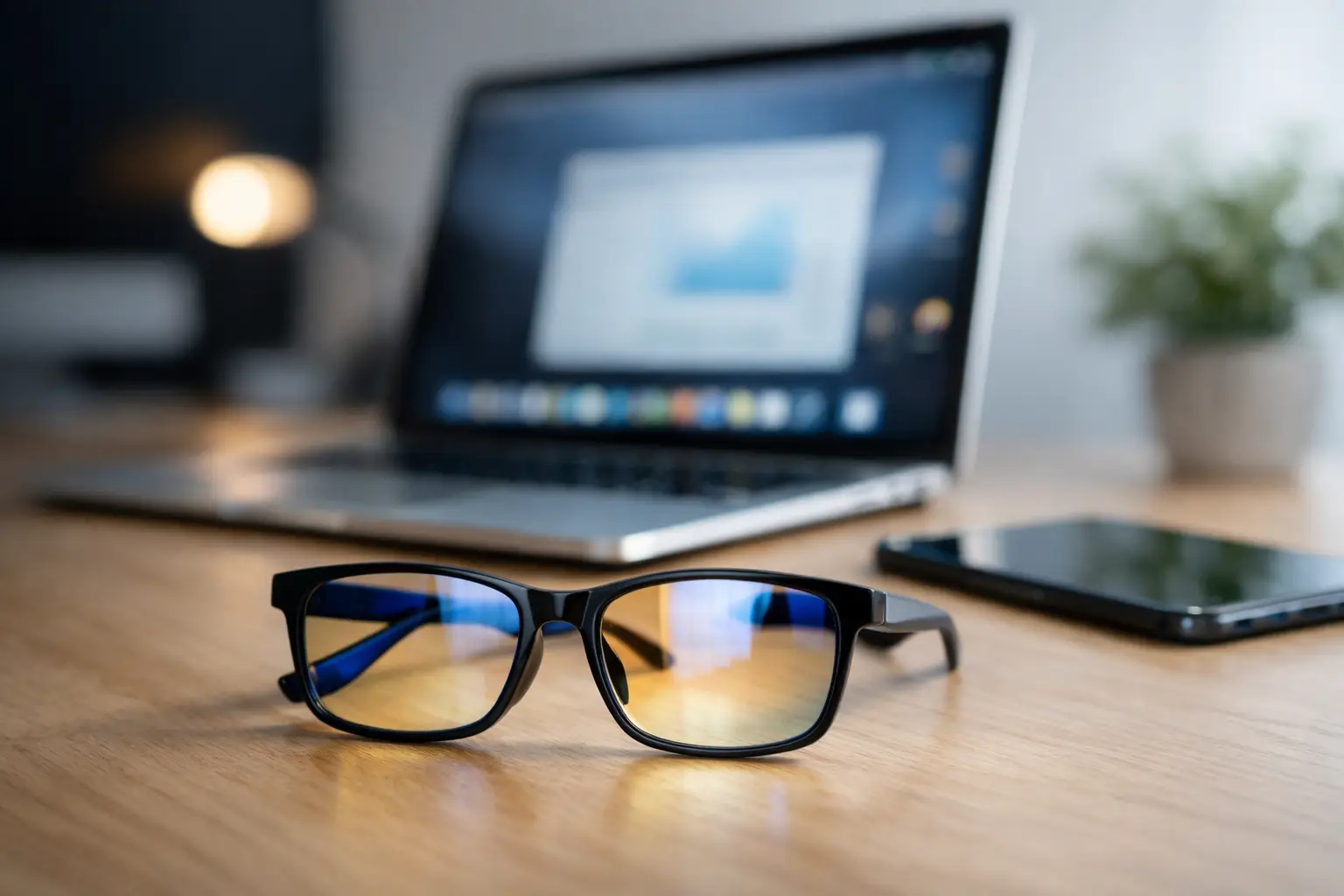
If you have ever bought screen glasses and found that they all seem to promise the same thing, then the overview of screen glasses filter levels is exactly the place to unravel the confusion. The biggest difference is often not just in the frame or price, but in how much blue light the lens actually filters and when that filter is really beneficial for you. The wrong level may be too weak, while too strong a level may feel uncomfortable for daytime work.
Overview of Screen Glasses Filter Levels – why does it even matter?
Not all screen glasses are designed for the same use. Some models are mainly made for daytime office work to reduce eye fatigue, dryness, and strain. Others are intended for evening use, where the goal is besides eye comfort also to reduce the part of blue light that can affect falling asleep.
Here lies the main point. The higher the filter level, the more blue light the lens blocks. This can provide stronger protection, but it can also come with a warmer tone, color perception changes, and a less neutral image. In other words, more doesn’t automatically mean better. The right choice depends on when you wear the glasses, how long you spend in front of the screen, and what you are doing at the same time.
What does filter level mean in practice?
The filter level essentially shows how much of a certain range of blue light the lens blocks. Different terms are used in the market, and this is where misunderstandings begin. Some talk about percentages, some about blue light blocking, some about UV-400 protection, some about yellow or orange lenses. These are not the same thing.
For example UV-400 means protection against ultraviolet radiation. This is a very good feature, but it does not automatically describe how much blue light in the visible spectrum the screen glasses block. Similarly, a completely clear lens does not mean there is no filter, nor does a yellowish lens always imply maximum protection.
Practically speaking, filter levels can be divided into three usage logics. A lower filter is suitable for those who want the most natural color tone and light support during a long workday. A medium filter is suitable for those who spend a lot of time in front of screens and feel eye strain or headaches by evening.High filter is intended more for evening and late-night use, when color accuracy is not the priority but stronger light load reduction is.
Low filter level
A low filter level is well suited for daytime work, studying, and meetings. The lens is often quite transparent and discreet in appearance, which appeals to those who want to wear glasses all day without significant color change. If your main concern is screen fatigue, mild irritation, or simply wanting to reduce eye strain, this may be completely sufficient.
However, it must be honestly said that if you sit for several more hours in the evening between your phone, laptop, and TV, a low filter may not be enough to support your sleep mode. It contributes to comfort but is usually not the strongest choice for late screening time.
Medium filter level
The medium filter level is the most balanced choice for many. It provides more noticeable protection than a very light filter but usually does not change the color tone so much that work or study suffers. This is the level often preferred by people who work daily at a computer and want a solution they can actually use every day.
If by evening you experience heavy eyes, forehead tension, or the feeling that the screen is simply too bright, the medium filter level is often the most sensible first step. It is also a practical choice if you do not want to have multiple different pairs for different situations.
High filter level
A high filter level means a noticeably stronger reduction of blue light. The tint of such lenses may be distinctly yellow, orange, or redder, depending on the protection level. These glasses are usually not intended for you to do color-critical work all day long. They are meant to make evening screen time less stressful for the body.
If you use screens late, tend to stay up late, or feel that after a long evening on your phone it is harder to fall asleep, this is where a higher filter level comes into play. This does not mean that the glasses do the work for you. If while going to bed you are also watching bright series, work emails, and social media, it’s not realistic to expect miracles just from the lens. But with proper use, the difference can be noticeable.
How to choose the right filter level for yourself?
The right answer begins with an honest question – when do you actually wear these glasses? If your workday lasts from eight to five and you mainly need glasses for computer work, a lens with too strong a tint might become distracting. But if your biggest problem occurs in the evening when the phone and laptop usage doesn’t stop, then a light filter intended for daytime work might be too weak.
It also depends on how sensitive your eyes are. Some people feel relief with a moderate filter. Others notice a difference only with stronger protection. The type of work is also important. A designer, photographer, or video editor needs a different solution when working with colors than someone who answers emails, manages spreadsheets, or participates in video calls.
A good rule of thumb is simple. Daytime work and a natural picture – choose a light or medium filter. Long screen time from morning to evening – a medium filter is often the most comfortable compromise. Evening use and stronger support for sleep mode – choose a higher filter.
How to tell if your current filter level is not suitable?
Sometimes the question is not whether the screen glasses work but whether they fit your usage habits. If you wear the glasses regularly but your eyes are still very tired in the evening, the filter may be too weak. But if you feel that working with the screen is uncomfortable, the picture too warm or colors off, the filter might be too strong for your daytime use.
It is also worth noting whether you actually start using the glasses or they remain in a drawer. If the model is uncomfortable, too dark in tint, or doesn’t fit your style, you won’t get used to wearing them. And if a habit doesn’t develop, the benefits won’t come either. Therefore, the filter level is not the only thing that matters. Frame fit, lens tint, and whether you like wearing them are equally important.
Overview of screen glasses filter levels from a purchase decision perspective
When you look at the product information, don’t get stuck on just one keyword. Ask yourself whether the description specifically talks about blue light filtering or only general protection. Is the lens intended for daytime use or stronger evening blocking? Is the tint almost transparent or deliberately stronger? The clearer the manufacturer explains the use case, the easier it is to make a good choice.
Here the price issue also comes in. The cheapest pair may seem like a quick solution, but if the filter level is unclear or the lens quality is inconsistent, the wearing comfort may not be what you expect. At the same time, the most expensive model doesn’t have to be the right one automatically. A sensible purchase is one where the protection level, comfort, and your actual usage fit together.
An advantage in the Estonian market is that the selection has become much clearer. Specialized players, like sininevalgus.ee/, are increasingly talking not just about the existence of glasses but about which filter level is reasonable for which user. This helps avoid the typical disappointment when a person tries the wrong glasses and decides too quickly that screen glasses are useless.
Could one pair cover all situations?
It could, but not always perfectly. If you want one pair that suits work, studying, and moderate evening use, an average filter level is usually the most flexible. It may not be the maximum solution in every situation but is the easiest for everyday life.
But if you know your days and evenings are very different, using two pairs for different purposes might be even smarter. One more neutral for the day, the other stronger for the evening. This is not an exaggeration but the same logic as for sunglasses and regular glasses – different situations require different solutions.
In the end, you don’t just choose the filter percentage. You choose how your eyes feel after a long workday, how easy it is to slow down the pace in the evening, and whether the glasses fit so well into your daily life that you actually want to wear them. A good filter level doesn’t shout the loudest on paper but works invisibly and consistently in your routine.