
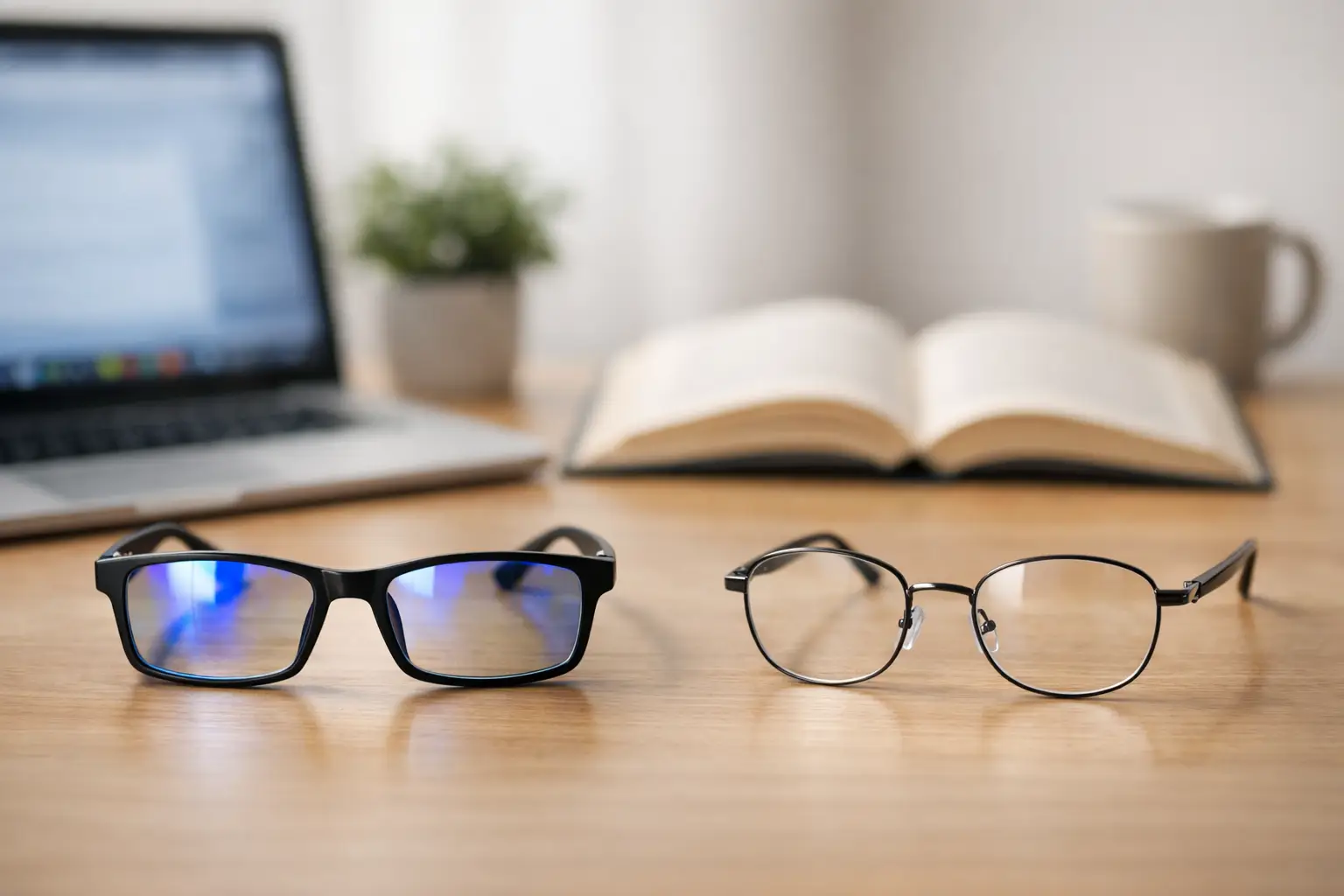
If the day passes in front of a screen and by evening the eyes are dry, heavy, or simply tired, the question quickly arises – computer glasses or reading glasses? These two are not the same, although at first glance they may seem similar. The right choice depends on whether your main concern is focusing up close or rather long screen time, blue light, and eye strain.
Many people buy their first pair of glasses precisely when the phone, laptop, and workday start to take their toll. Often, something is simply chosen to make the text bigger. This can help short-term, but the wrong type of glasses does not solve the real problem. Sometimes they even make the feeling worse.
Computer glasses or reading glasses – what is really the difference?
Reading glasses are primarily designed for viewing up close. Their purpose is to help the eye focus on small text, for example in a book, on packaging, or on a phone. They are mostly used when age-related changes in near vision start to be felt, and small print is uncomfortable to read without assistance.
Computer glasses operate on a different logic. They are designed for working with screens, where the eyes do not make just one movement nor maintain one fixed distance. Looking at a screen means long concentration, less frequent blinking, artificial light, and the effect of blue light. The role of computer glasses is not just to enlarge the image but to support eye comfort over longer screen time.
This is where most wrong choices are made. If you use reading glasses at the computer, the text may appear sharper, but the working posture can get misaligned. You may lean too close to the screen, causing neck and shoulder tension, and eye strain might not decrease. Screen work is not the same as reading a book on the couch.
When are reading glasses the right choice?
Reading glasses are suitable when the problem mainly arises when reading small text up close. For example, a menu, label, newspaper, or phone screen looks blurry, but you see well at a distance. This is very common from the age of 40 but can appear earlier.
If you read short amounts of time and specific text, reading glasses can be completely sufficient. They are practical, simple, and for many a good first solution. However, they are not made for viewing a monitor that is 60-80 cm away all day long. A computer screen is usually farther than a book and closer than a TV, so the working distance is different.
If you notice that reading a book with reading glasses is comfortable, but you quickly experience strain or headaches when working at the computer, this quite clearly indicates that the need is no longer just related to reading.
When are computer glasses a better choice?
If you work, study, or create in front of a screen for several hours a day, computer glasses are usually a more logical choice. They are well-suited for office workers, designers, students, accountants, assemblers, programmers, and anyone who moves between a laptop, phone, and another monitor throughout the day.
Computer glasses help reduce discomfort related to screen use. People usually describe it very simply – you don’t get so squinty by evening, your eyes are not as dry, your head is clearer, and you fall asleep more easily. This doesn’t mean that glasses make screen work disappear, but they can make a long day noticeably more bearable.
Computer glasses are especially a good choice if you do not have a direct vision problem but feel strain from the screen. In such cases, lenses with magnification are not necessarily needed. What may be required is rather blue light filtering and a more comfortable visual experience.
Are blue light glasses and computer glasses the same thing?
In practice, these terms are often used together, but they do not always exactly overlap. Computer glasses may include a blue light filter, anti-reflective coating, or other solutions that support comfort in front of the screen. Blue light glasses specifically focus on reducing the bluish light coming from screens and light sources.
If your main concern is evening screen time, eye fatigue and difficult falling asleep, then blue light filter computer glasses are a very relevant choice. If you also need support for near vision, these features can sometimes be combined. There is no one universal answer here – what matters is how and how long you actually use the glasses.
Computer glasses or reading glasses for office work
During office work, you may look alternately at the monitor, phone, notebook, and colleague across the table throughout the day. This means that the eye has to constantly adapt. Reading glasses work best in a fairly fixed close range. If the screen is further away than that, you start compensating with body posture or feel that the image is not quite comfortable.
Computer glasses are usually more reasonable in this environment because they take into account the real use of screen work. If you sit in front of the screen for several hours every day, the issue is not only visual acuity. The issue is also how you feel at the end of the workday.
That’s why many people look for glasses that look good and are comfortable to wear all day long. A function without style often ends up in the drawer. A good pair of computer glasses is the kind you put on in the morning and don’t want to take off after half an hour.
Common misconception – if I see well, I don’t need glasses
This is one of the most common thoughts. Vision can be perfectly fine, but the eyes still get tired. The reason is not always that the image is blurry. Screens strain the eyes even if you can see the text well. You blink less, focus on one distance for a long time, and are exposed to intense light.
So computer glasses are not only for those with poor vision. They are also meant for those whose workday is digitally intense and who want to reduce the daily strain. This is a very practical difference.
How to make the right choice for yourself?
Start with a simple question – in what situation do you experience discomfort? If it’s only when reading small text, reading glasses might be sufficient. If the problem arises particularly after computer, phone, or evening screen time, it’s worth considering computer glasses.
The second question is the duration of use. Five minutes of reading a prescription and eight hours in front of a monitor are completely different situations. A solution suitable for short close-up reading is not automatically good for an entire workday.
The third question is how you feel at the end of the day. If your eyes sting, your head feels heavy, and you sleep worse after screen time, it is quite clear that you need something more than just magnification. In such cases, quality computer glasses are usually a smarter investment.
When might you need both?
Yes, this is entirely possible. A person might need one pair of glasses for reading books and another for working with a computer. This is not an exaggeration, but a practical solution for different viewing distances and habits. If your day includes a lot of different types of visual work, one pair of glasses does not necessarily have to cover everything.
This happens especially often after the age of 40 when focusing on close distances naturally becomes more difficult, but work and communication still largely take place on screens. In this case, it’s worth thinking about comfort, not just whether one pair can somehow suffice.
What to pay attention to when buying?
Do not choose glasses just because they seem cheap or “approximately suitable.” Especially for screen work, it matters how the glasses actually fit on your face, the coating of the lenses, and whether they are suitable for your everyday use. A comfortable frame, reliable filter, and quality finish affect much more than you might initially think.
If you want a solution that you can really wear, appearance matters too. Glasses are part of everyday style. Modern design and effective protection are not mutually exclusive – on the contrary, the best choices combine both.
sininevalgus.ee/ the focus here is very clear – to provide glasses for screen-based life that don’t look like a makeshift solution but rather a natural part of your day.
If you are torn between choosing computer glasses or reading glasses, don’t just ask which makes text appear sharper. Instead, ask which makes your eyes feel better at the end of the day.