
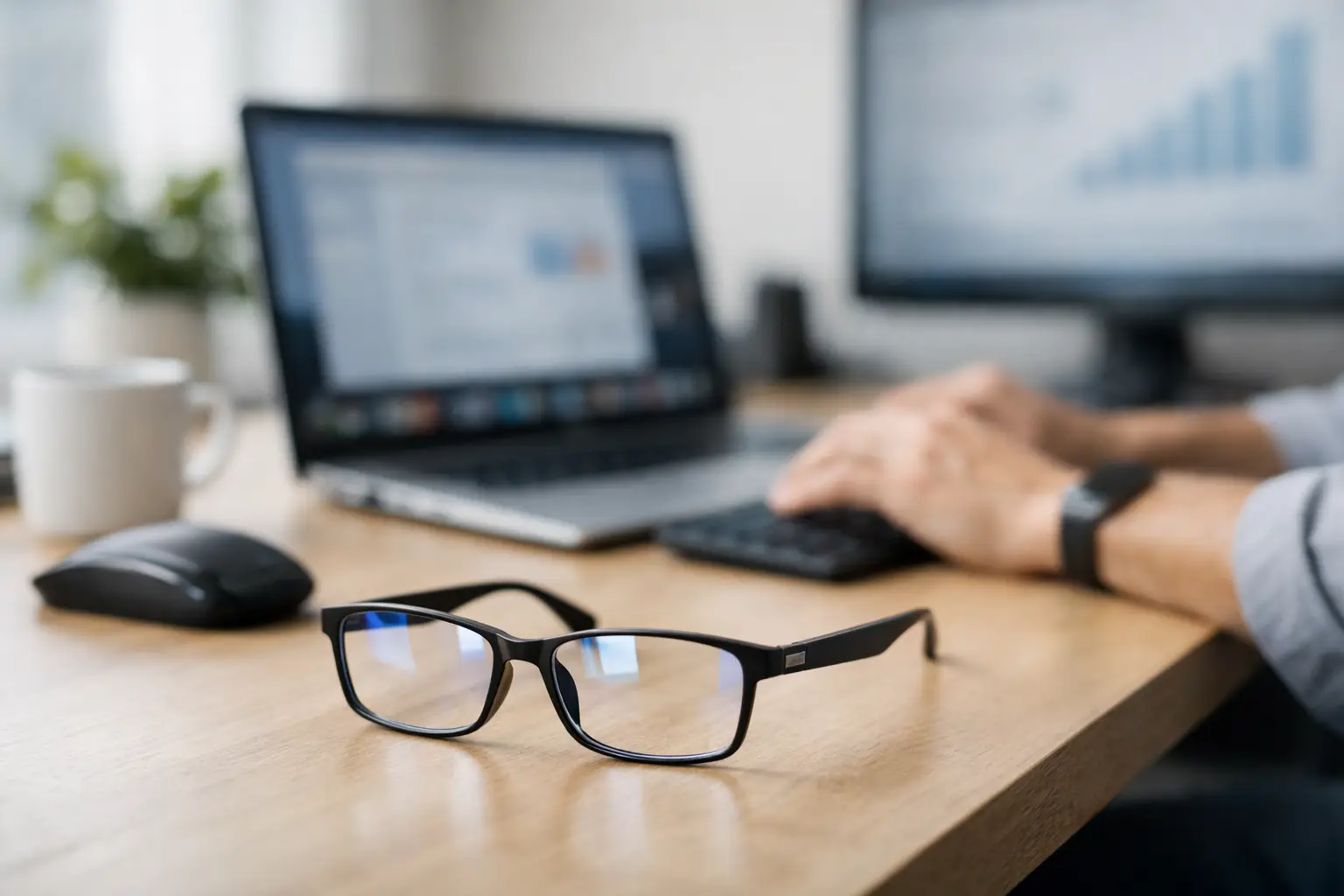
If your workday starts in front of a screen and ends in the same place, the question is no longer whether your eyes get tired, but how quickly. The best glasses for digital work are not just a fashion accessory, but a practical tool that helps reduce eye strain, dryness, tingling, and that familiar feeling of having a heavy head by evening.
Many get used to these symptoms. Vision becomes blurrier, eyes turn red, it’s harder to fall asleep at night, and concentration at the end of the day is worse than it should be. If the screen is part of your daily life, it’s worth being demanding when choosing glasses. Not all blue light glasses work the same way and not all frames are suitable for a full workday.
What are the best glasses for digital work?
A good screen glasses do more than just one thing. It must reduce disturbing light exposure, fit comfortably, look good, and suit your real day, not just the product photo. If glasses slip down your nose, press on your temples, or distort your view, they will soon end up in a drawer. Therefore, the best choice is always a balance between protection, comfort, and style.
For digital work, the most important feature is the lens function. The goal is not to make the world yellow, but to filter the part of light that strains the eyes the most during long screen time. This is where a high-quality blue light filter comes into play. It helps reduce visual stress, especially when working on a bright monitor, switching between multiple devices during the day, or continuing on your phone in the evening.
Another important topic is anti-reflective coating. If there are overhead lights in the office, a window behind you in your home office, or the screen itself is very bright, reflections quickly become tiring. A good lens cuts out this flickering distraction and leaves the image cleaner. The result is not only a more comfortable feeling in the eyes but also more stable concentration.
What to look for before buying
When choosing glasses for digital work, don’t start just with the frame. Start with how long you actually look at the screen. A person who spends a couple of hours a day on emails needs a different solution than a designer, programmer, remote worker, or student whose day is spent between a laptop and phone.
If you use screens mainly during the day, it is worth looking for glasses with a balanced filter that are suitable for long wear and do not disturb color perception annoyingly. This is especially important for those who work with design, photo, video, or other visual content. A very strong tint might be useful for some, but in creative work it can start to interfere.
If the problem is rather evening fatigue or difficulty falling asleep after long screen time, then a higher protection level solution may be needed. Here, usage time plays a big role. For daytime work, glasses with a more neutral lens are usually best. For late evening use, a stronger filter might give better results, especially if the screen remains in front of you after the workday.
Frame matters more than it seems at first glance. A light frame is suitable for long days because it does not press on the nose bridge or behind the ears. A wider lens covers the field of view better, which is useful when you look alternately at a monitor, another screen, and notes. Narrow or very small glasses may look stylish but are not always the most practical during a workday.
Why cheap glasses often fail
There are many glasses on the market that promise blue light protection but leave important details blurry. If there is no clear information about the filter level, lens properties, and intended use, you basically buy by guesswork. It might work, but often it does not.
Lower-end products have two typical problems. First, the filter may not be effective enough for you to notice a real difference. Second, the lens itself may be optically inferior, which means additional reflections, distortion, or simply uncomfortable wear. The result is ironic — glasses that were supposed to protect the eyes start to tire them.
This does not mean that the most expensive model is automatically the best. However, it does mean that for glasses designed for digital work, it is worth preferring a specialized choice, where the focus is on real user experience, not just general packaging promises.
The best glasses for digital work are not the same for everyone
This is where the part that is too rarely honestly said comes into play – the best glasses for digital work depend on your work style. An office worker who spends eight hours in Excel and Teams usually needs a comfortable, lightweight, and everyday solution. For a student, it’s important that the glasses fit for lectures, the library, and evening studying. A creative worker looks not only at protection but also that the frame supports personal style.
If you wear glasses every day, the model must fit your face naturally. A design that is too strong might appeal to some people, but if you don’t feel good wearing them, you won’t develop the habit of wearing them. And without wearing them, there is no benefit. A good screen glass is one you put on without thinking because it feels right.
That’s why a wide range of models is important. Different frame shapes, color tones, and price levels are not just a matter of aesthetics. They provide the opportunity to find glasses that work on your face and in your daily schedule. When function and appearance are both in place, the result is much stronger.
What are the real benefits of well-chosen screen glasses?
The biggest change may not come as a dramatic wow effect in the first hour. Often, you notice it at the end of the day instead. Your eyes aren’t as dry, your forehead doesn’t feel tight, the evening screen isn’t as harsh, and the end of the workday doesn’t feel as exhausting. For many, concentration also improves because visual strain is not draining energy in the background.
The topic of sleep deserves special attention. If you work in the evenings or use your phone, tablet, and TV after work, your body still receives signals to stay alert. Here, the right glasses can make a noticeable difference. Not as a miracle tool, but as part of smarter screen use.
If you add more conscious screen brightness, regular blinking, and a few breaks, the effect will increase. Glasses alone won’t solve everything, but they can be the simplest change that brings noticeable relief to every workday.
How to choose a model that you will actually keep wearing
Start with an honest question – do you want glasses only for work or for all-day use? If you need them from morning to evening, prefer a classic and light model that fits for meetings, cafés, and the home office. If you’re looking more for stronger protection for evening use, a more specific solution may be suitable.
Also consider where you work. In an open office, the anti-reflective feature may be more important than at home. If you move around a lot, the frame’s durability and comfortable fit matter. If appearance is important to you, don’t make a compromise you’ll regret later. Effective glasses can also be stylish.
sininevalgus.ee/ is popular in Estonia precisely because the selection does not force you to choose between protection and appearance. If a product is designed specifically for screen use and also looks good, it is easier to make it part of everyday life.
Common mistakes to avoid
One of the most common mistakes is waiting until problems become daily. If your eyes are constantly strained, headaches frequent, and sleep disturbed, looking for a solution is long overdue. Another mistake is choosing glasses based only on price. With digital work, you spend hundreds of hours with them – this is not the place where a random choice justifies itself.
The third mistake is buying a model that looks good in photos but does not suit your face shape or wearing habits. If the glasses are uncomfortable, they are easily left unused. And the fourth mistake is assuming that one solution fits all screen habits. Daytime work, evening scrolling, and late-night binge-watching do not strain the eyes in exactly the same way.
When you choose glasses consciously, the result becomes much better. Not only for your eyes but for your overall well-being. Because a good workday shouldn’t end with red eyes, a heavy head, and a restless evening. Sometimes the difference starts with one simple decision – putting on glasses that are truly designed for digital work.