
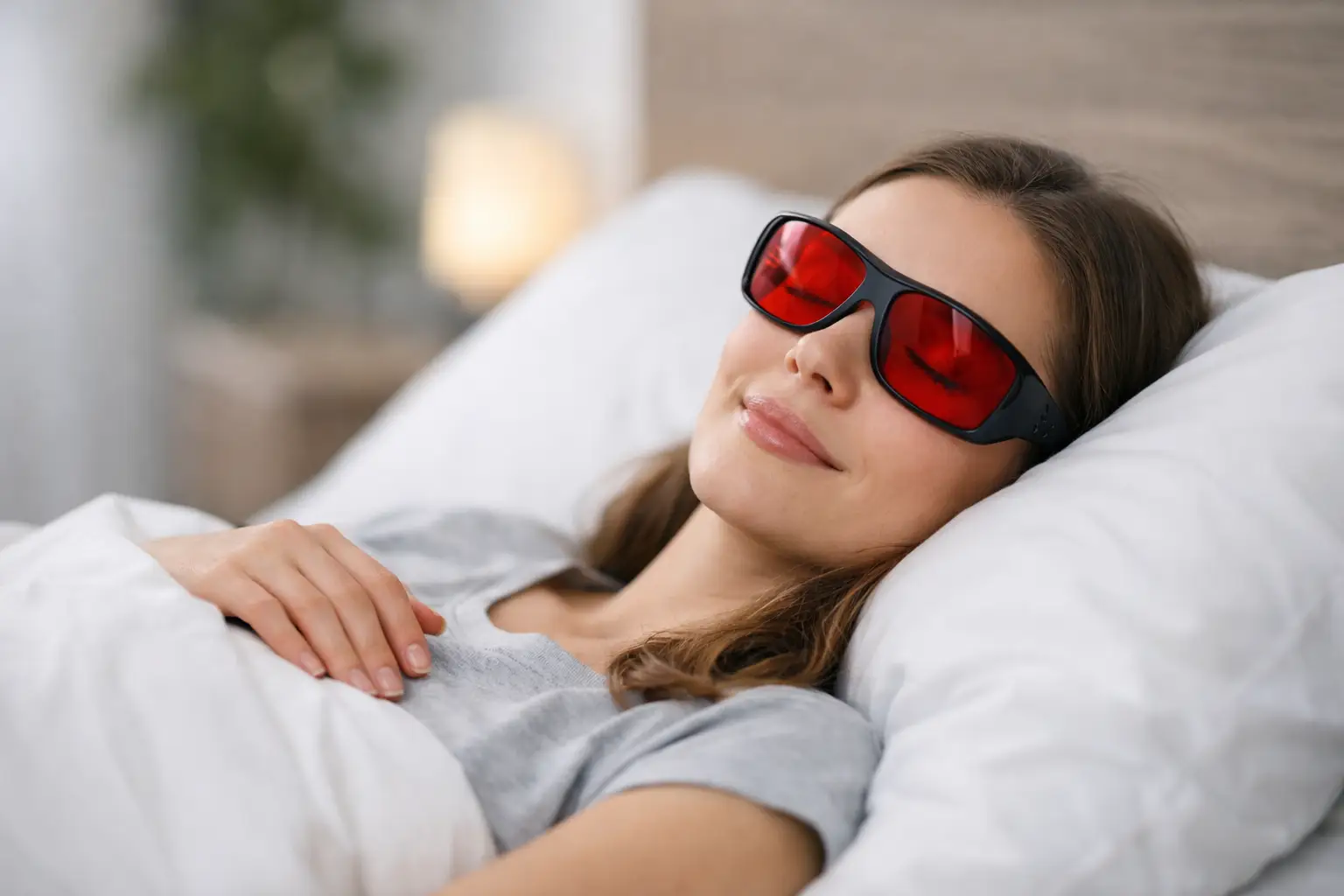
If you notice that your phone won’t leave your hand in the evening, sleep drags on, and your head still feels like it’s at work by the end of the screen day, then red lens glasses for sleep are not just a trend product. They are very specifically designed glasses for people who want to better control evening light and give their body a clearer signal that the day is coming to an end.
The usual situation is simple. You work on the computer during the day, answer messages, watch a series in the evening, or scroll in bed. Your eyes get tired, but your brain doesn’t calm down. This is where the role of glasses with a stronger filter with red lenses comes in – they are intended for evening use when the goal is not only eye comfort but also better readiness for sleep.
Why are red lens glasses for sleep used at all?
In the evening, light affects more than many think. Especially significant is light with shorter wavelengths, which comes from screens, LED lights, and also bright indoor lighting. If there is too much of this light too late, the natural daily rhythm of the body can be disrupted.
Red lens glasses are designed to block significantly more blue and green parts of the light than regular screen glasses. This difference is important. While classic blue light glasses are well suited for daytime work and long screen time, red lens glasses are rather intended for the evening when you want to strongly reduce the impact of light.
Practically, this means that the glasses can help you calm down faster in the evening. Not everyone feels the effect the same way on the first evening, but many notice less eye irritation, less disturbance from bright light, and that falling asleep feels more natural. If your evenings are spent with screens, this is a completely logical next step.
How do red lens glasses for sleep work?
So it’s not only the lens color. The red tone indicates that the lens filters out more aggressively those parts of light that can keep alertness up in the evening. The stronger the filter, the more the visual scene itself changes – white tones become warmer, bluish tones disappear, and the entire environment feels softer.
This may initially feel unfamiliar, especially if you have only worn glasses with transparent or slightly yellowish filters so far. But the purpose is different. These glasses are not made for wearing all day in the office. They are made for the evening window, usually 1-3 hours before bedtime, when you want to reduce the stimulating effect of light.
The later the time and the brighter the environment, the more beneficial a stronger filter is. If you work night shifts, assemble late, study for exams, or simply cannot avoid screens in the evening, then the red lens solution is often more effective than a regular blue light filter.
When to choose glasses with red lenses, not regular screen glasses?
It depends on the goal. If your main concern is daytime eye fatigue, dryness, tingling, or headache during long screen work, then regular screen glasses are generally the better choice. They are more neutral, comfortable for daily wear, and do not change color perception as much.
But if the problem occurs specifically in the evening – you can’t fall asleep, the body is tired but the mind stays alert – then it is worth looking towards red lens glasses with a higher protection level. They do not replace good sleep routines but help to significantly reduce light exposure when it matters most.
Many people actually use two different solutions. During the day, lighter filtered screen glasses, in the evening, stronger red lens glasses. This is a practical approach because daytime needs and evening needs are not the same.
Who are red lens glasses best suited for sleep?
The glasses are especially suitable for people whose evenings are screen-centric. An office worker who finishes work on a computer and continues afterward on a phone. A student who studies late into the night. A content creator, designer, or editor whose workday stretches into the evening. Also a parent who only gets their time once the home quiets down.
If you feel tired and alert at the same time in the evening, the cause may partly be the lighting environment. This doesn’t mean glasses alone solve everything, but they do provide a very specific advantage. Less brightness, less strain, fewer distracting blue tones.
That said, it’s worth being honest – if your evening sleeplessness is related to stress, caffeine, irregular schedules, or health issues, glasses alone won’t work miracles. They work best when used together with a reasonable evening routine.
What is normal to feel during the first uses?
The first feeling is usually that the world turns very warm. This is expected. Glasses with red lenses significantly change the tone of light in the room, and that is part of their function.
Some get used to it within a few minutes, others within a few evenings. If you put on the glasses about 1-2 hours before sleep, the change is often the most natural. If you wear them only five minutes before going to bed, the effect may be smaller.
It is also important that red lens glasses are not always comfortable for color-sensitive work. If you have to design, edit photos or do detailed visual work in the evening, the strong tint can be a compromise. In that case, you must choose whether your priority is accurate color perception for work or reducing light exposure before sleep.
How to correctly use red lens glasses in the evening?
The best results usually come when you put on the glasses before the body is already overtired. A good rule of thumb is to start 1-3 hours before bedtime. If you know you will still be using the phone, TV, or computer, it’s worth putting the glasses on right at the start of that evening period.
Room lighting also matters. If you wear glasses but sit in very bright LED light, the glasses will do their job, but the entire environment can still stimulate you more than necessary. It’s wise to combine glasses with warmer and softer evening lighting.
And one more important nuance – consistency matters more than a single perfect evening. If you use red lens glasses occasionally, you may only notice a small difference. If you make it a conscious habit, the effect is often more noticeable.
How to choose the right red lens glasses for sleep?
When choosing, it is worth looking at three things: filter level, wearing comfort, and style. The filter level determines how strong the light blocking is. For sleep purposes, it is worth looking at higher protection level solutions, not just lenses with a cosmetically redder tone.
Wearing comfort is equally important. If the frame presses, slips, or feels awkward on the face, the glasses will just end up in the cabinet. Since they are used in the evening at home, on the couch, at the computer, or in bed while reading, the model must be light and natural to wear.
Style is not a trivial matter. If the glasses look good, you are much more likely to actually use them. This is also why more and more models are chosen that combine strong function and a modern appearance. sininevalgus.ee/ focuses on ensuring that glasses should not feel like a medical compromise, but a well-thought-out everyday choice.
Are red lens glasses for sleep suitable for everyone?
They are suitable for many, but expectations should be realistic. If you are looking for quick help to reduce evening screen exposure, these are one of the more practical tools. If you expect the glasses to solve years of sleep problems without changing any other habits, that is not quite a fair expectation.
It is also worth considering your lifestyle. If your evening is very active, moving a lot between home and outdoors, or you need accurate color perception, a red lens may not be the most comfortable in every situation. But if the evening reality is more about screens, indoor lighting, and the desire to reach a relaxed state faster, this is a very well-targeted solution.
The simplest way to assess the matter is to ask yourself one question: does my evening lighting environment help me fall asleep or keep me awake? If the answer is the latter, then red lens glasses for sleep are not a superfluous accessory but a smart tool.
Good sleep doesn’t start with lying down in bed. It starts from the moment you signal your eyes and brain that the day can calm down.