
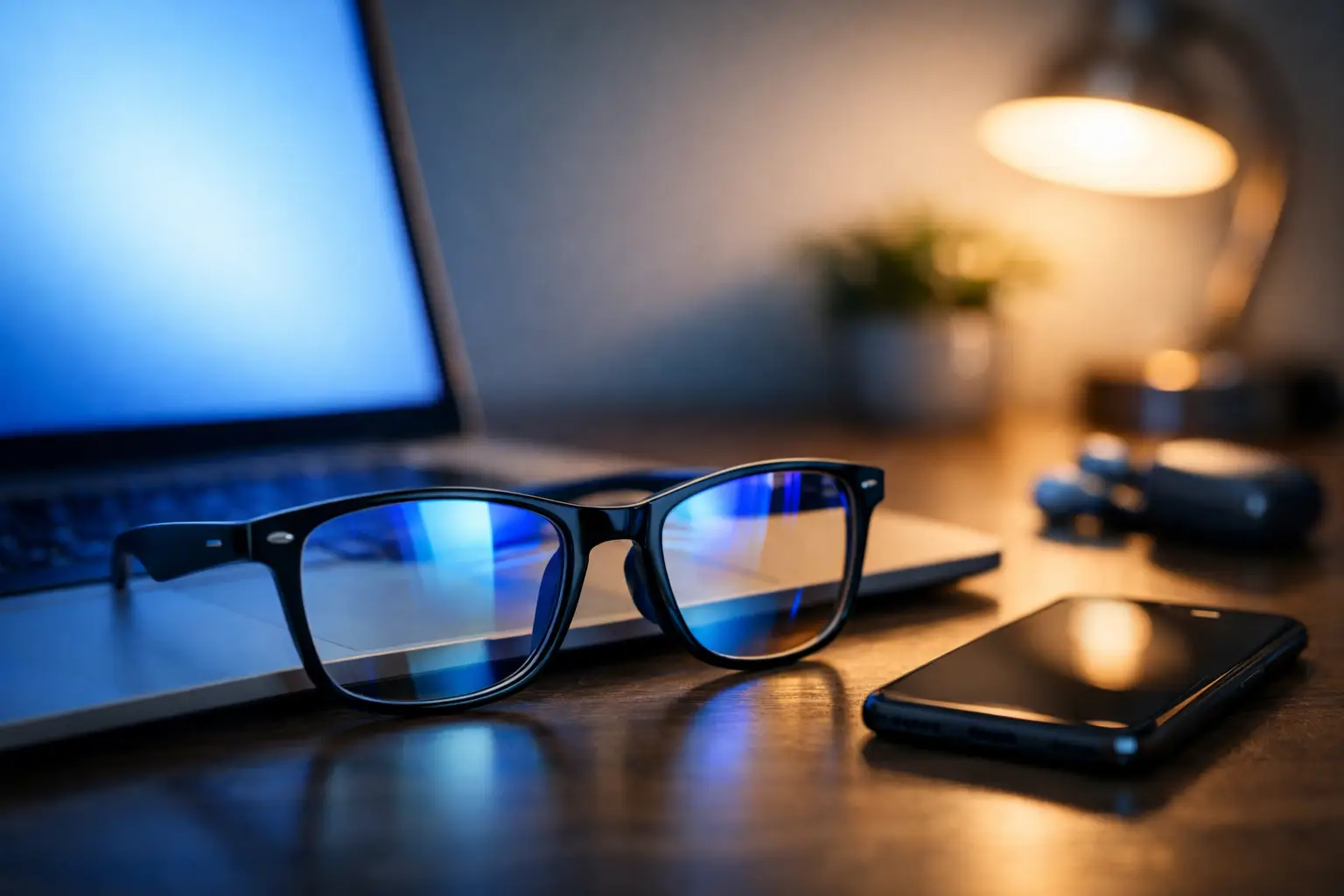
When the day ends with itchy eyes, a heavy head, and trouble falling asleep, a completely justified question arises – how do blue light glasses work and are they really beneficial. The short answer is simple: these glasses filter part of the blue light spectrum coming from screens to reduce eye strain and help the body switch to a calmer state in the evening. But that doesn’t mean all blue light glasses are the same or suitable for every situation.
How blue light glasses work in everyday use
Screens don’t emit just one type of light. Phones, laptops, monitors, and TVs emit a broad spectrum of light, within which there is also blue light. It is the shorter wavelength blue light that can irritate the eyes more during prolonged screen time and affect the body’s natural sleep rhythm in the evening.
Blue light glasses lenses use a special filter or coating that absorbs or reflects part of this light back. The result is that less high-energy blue light reaches the eye. This doesn’t make the screen dark or make usage uncomfortable, but it can reduce the feeling that your eyes are overworked at the end of the day.
Many users notice the difference especially in the evening. If before the eyes seemed dry, the light too bright, and the brain somehow too alert, then with properly chosen glasses, being in front of the screen can be softer. It is not a miracle cure, but a quite specific optical solution for a specific problem.
What the lenses actually filter
This is where most wrong assumptions are made. Blue light glasses usually do not block all blue light because that wouldn’t be practical either. During the day, some blue light is perfectly normal and necessary as it helps maintain alertness and supports the body’s natural circadian rhythm.
Mostly the goal is to reduce just the part of the light coming from screens that can increase eye strain during long use. With a lighter filter screen glasses is intended for daytime work, studying, and general screen use. Glasses with stronger filters, especially with a reddish or darker tint red lens models, are meant more for evening use when the goal is to minimize light that disrupts the sleep rhythm as much as possible.
This difference is important. If you work with design, video, or photography, too strong a filter can alter color perception. However, if you scroll on your phone in bed for another hour, a stronger protection might be what helps your body enter a resting state earlier.
Why eyes get tired in front of a screen
Blue light is not the only culprit. Eye fatigue usually arises from a combination of several factors. When looking at a screen, we blink less, eyes dry out faster, focus remains fixed at the same distance for a long time, and bright light strains the visual system more than necessary.
That’s why many people feel tingling, redness, or heaviness in the eyes at the end of the day. Adding evening phone use in a dark room makes the strain even greater. Blue light glasses help reduce this strain, but the best results come when they work together with reasonable habits – for example, adequate room lighting, breaks, and appropriate screen brightness.
Do blue light glasses also help improve sleep?
This question often determines whether a person decides to try the glasses. The answer is: yes, they can help, but the effect depends on timing and type of glasses. In the evening, blue light affects melatonin production, a hormone that signals the body it’s time to rest. If you get a lot of bright screen light before bedtime, your brain may stay in daytime mode for too long.
That’s where models with stronger filters come in. If the goal is to reduce the impact of evening screen use on sleep, lightly filtering clear lenses may not always be sufficient. Regular workday screen glasses and evening glasses with higher protection do not fulfill exactly the same role.
It’s worth being honest – if someone drinks an energy drink at 10 PM, works in bed, and watches a bright show for another hour, glasses alone won’t solve everything. They help, but they do not replace an evening routine.
How blue light glasses work with different lenses
Not all filters behave the same way, and this is where the most confusion arises during purchase. Clearer blue light glasses are suitable for people who want to work in front of a monitor daily without colors changing too much. They are practical in the office, school, and home office, where glasses are worn for several hours in a row.
Lenses with a more yellowish tint usually filter more strongly and can provide quicker relief for the eyes, especially when the screen is bright or use is long. The downside is that the white tone becomes warmer and color-sensitive work might not be as comfortable.
Glasses with red lens types take it a step further. They block a larger portion of the blue light that disrupts the sleep cycle and partially also green light. This makes them a very good choice for evening use but not always the best option in the middle of the workday. If you need precise color perception or spend a lot of time in public spaces, this tint may be too strong.
Who benefits the most from these
If you spend 15 minutes in front of a screen a day, you might not notice a big difference. However, if you work on a computer, study online, edit videos, manage social media, or use your phone until late at night, the benefit is much more likely.
Blue light glasses are especially suitable for people who regularly experience eye fatigue, dryness, headaches, or evening exhaustion. Also for those who want to use a screen in the evening but don’t want it to delay sleep. This is why screen glasses have become such a common tool both in the office and at home.
It is also important that glasses do not have to look like a medical compromise. Nowadays, it is completely justified to expect that they fit daily style. Function and appearance no longer have to exclude each other.
When blue light glasses alone are not enough
If you already have severe vision problems, glasses with the wrong strength, or constant headaches, you shouldn’t blame all concerns on blue light. Sometimes the real cause is uncorrected vision, dry eyes, poor posture, or too close viewing distance.
These glasses also don’t make screen use unlimitedly healthy. If you sit in front of a monitor for ten hours straight without breaks, the strain will still be significant. A good filter helps, but a sensible usage habit is just as important.
That’s why it’s worth looking at the bigger picture. If the goal is to actually feel better at the end of the day, glasses work best together with small but consistent habits.
How to choose the right pair for yourself
When choosing, it’s first worth thinking not about which frame you like most, but when you will use the glasses. If you need them during the workday, choose a lighter filter and a comfortable frame that you can wear for a long time. If your main concern is evening phone use and poor sleep, it’s worth looking at solutions with stronger protection.
Secondly, consider the nature of your work. If colors are important to you, prefer a more neutral lens. If color accuracy doesn’t matter and you want maximum protection, a stronger tint might be the better choice.
Thirdly, wearing comfort matters more than it seems at first glance. If the glasses press, slip, or feel heavy on your face, they will stay in the drawer. A good model is one that you want to wear, not one you have to remind yourself to wear.
That’s precisely why many Estonian buyers prefer a specialized selection where everyday screen glasses and models with higher protection levels are clearly distinguished. sininevalgus.ee/ has built its selection around this focus — so a person doesn’t have to guess but can choose according to their real needs.
Is the effect noticeable immediately?
For some people, yes. Especially if the eyes are already tired from long screen time, relief can come quite quickly. The light feels softer, eyes don’t sting as much at the end of the day, and evening screen time becomes more bearable.
Others notice a difference within a few days or weeks. This is normal because part of the effect is related to habits and usage time. If you wear glasses consistently at the moments when the load is highest, you usually notice the result more clearly.
The most honest expectation is this: blue light glasses do not turn screen life into a zero-load activity, but with the right filter selection, they can make a long workday and late evenings noticeably easier. And when your eyes feel better, you usually have more energy for the rest of the day as well.