
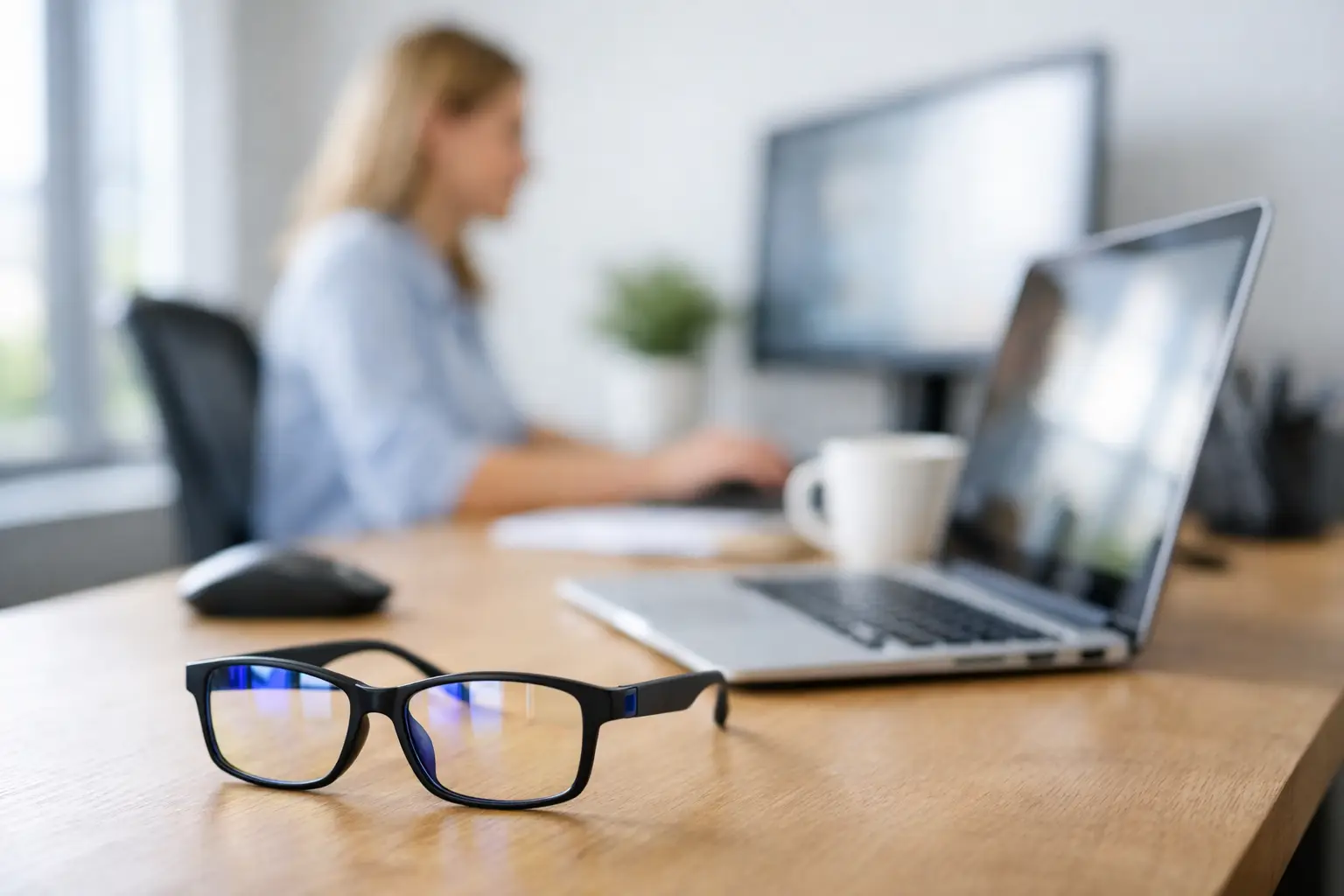
If a workday means 7-10 hours in front of a monitor, the question is no longer whether the screen affects your eyes, but how quickly you start to feel it. The best screen glasses for office work are not just a comfortable addition to the desk or a stylish detail on a video call. They are a practical tool for a person who wants to see clearly at the end of the day, feel fresher, and avoid that familiar eye strain that tends to bring headaches by evening.
In office work, the problem is usually cumulative. One long day doesn’t break anything, but over weeks and months, dryness of the eyes, squinting, concentration fatigue, and evening restlessness build up. Especially if you use multiple screens at once, work under LED lighting, or switch between computer, phone, and tablet throughout the day. Good screen glasses don’t make screen work disappear, but they help make its impact noticeably softer.
What are the best screen glasses for office work?
The best choice does not automatically mean the darkest lens or the most expensive frame. The best glasses for office work are those that filter blue light at a reasonable level, maintain natural color perception, and are comfortable enough to wear for several hours every day in a row.
If you mainly work in an office, balance is important. Glasses with too light a filter may not provide noticeable relief. Glasses with lenses tinted too darkly may alter screen colors in a way that is particularly troublesome for designers, marketers, editors, or anyone who values color accuracy. For most office workers, the best models are those that reduce the screen’s taxing component without making the work awkward.
A good sign is when you don’t have to struggle to get used to the glasses while wearing them. The image is clear, the screen doesn’t seem as sharp or “harsh,” and your eyes feel less tired at the end of the day. This everyday feeling matters more than the technical numbers alone.
What to actually look for when choosing screen glasses
The first thing is the type of lens. For office work, the most practical are transparent or lightly tinted screen glasses. These are suitable for daytime use, meetings, open offices, and home offices. They don’t create too strong a visual effect, but can still help reduce eye strain and the glaring effect of the screen.
The second important topic is coverage and protection. If the glasses have, in addition to a blue light filter, also UV-400 protection, that’s a strong plus. This is not just a marketing detail, but gives the glasses broader usability. If you move outdoors and back during the day or work near a window, this is simply sensible extra protection.
Third comes the frame. This is where people surprisingly often make mistakes. If the frame presses on your temples, slides down your nose, or fits unstable, even good lenses will end up unused. Glasses intended for office work should be chosen to be light, well balanced, and with a sufficiently neutral design to suit everyday use. Glasses need to work with your day, not require constant adjustment.
Fourth, consider whether you need a zero strength or prescription solution. If you already require vision correction, there’s no point in postponing it. Wrong glasses or screen glasses without correction can in some cases actually increase tension. If you see well without strength, it’s simpler – then you can focus on the filter, comfort, and design.
Why a cheap impulse buy may not be the best choice
The market for screen glasses is wide and honestly uneven. Very cheap models may seem like a good idea, especially if you just want to try something quickly. The problem is that cheap often comes with compromises – lens quality, wearing comfort, finish, and the actual filter level may not be what the advertisement promises.
If you wear glasses only a few times a month, this may not be such a big deal. But in office work, where glasses are used almost every day, small shortcomings quickly become annoying. Reflections on the lenses, uncomfortable frames, or too strong a yellowish tint may mean you’ll simply not wear the glasses.
That’s why it’s worth looking at screen glasses as a work tool, not an impulse purchase. The same logic applies to an office chair, mouse, or a good monitor. If you use something daily, it really has to work.
The best screen glasses for office work depend on your work style
Not all office work is the same. If your day mainly involves Excel, emails, and web meetings, you mostly need a universal and comfortable solution. Glasses with a clearer lens work well here because they don’t distort the work image and are easy to wear all day long.
If you are involved in creative work, such as design, video, or photography, color accuracy becomes more important. In that case, it is worth being careful with too strong a filter. The goal is not to remove all coolness from the screen but to reduce the strain so that vision remains natural. Sometimes a slightly milder filter that you wear consistently is better than a strong solution that ends up in the drawer.
If you work until late at night, two different solutions can be useful. More neutral screen glasses during the day, models with stronger protection levels in the evening. This is not necessary for everyone, but for someone who finishes work at 10 PM or uses screens right before sleep, the difference can be clearly noticeable.
How to tell if glasses are doing their job
The effect of screen glasses usually does not mean a dramatic “wow” moment in the first five minutes. The real value emerges at the end of the workday and during the week. Eyes are less dry, less itchy, the need to squint decreases, and evening headaches do not come so easily.
Many also notice that evening screen time feels softer. This doesn’t mean you can endlessly scroll your phone, but your eyes don’t get tired as quickly. If you have so far thought you were just “done with the screen,” the real reason may actually be constant visual overload.
At the same time, it is worth being honest – screen glasses do not solve everything. If you have poor lighting, a monitor that is too bright, incorrect working posture, and no breaks, no glasses will perform miracles. The best result comes when glasses are part of a smarter workday, not the only lifeline.
What else to pay attention to in the office
Even the best glasses have a stronger effect when the screen work environment is in order. The monitor should not be too bright compared to the room. In air-conditioned rooms, it is worth monitoring eye dryness. And if you find yourself staring at the screen for two hours straight without lifting your gaze, it’s time to correct the routine.
Simple things matter more than they seem at first glance. Reducing screen brightness, adjusting text size, occasionally looking into the distance, and conscious blinking can significantly improve the big picture. Screen glasses do not replace these habits but support them.
Style matters more than you think
No one wants to wear glasses that look like a temporary medical device while working in an office. If the glasses fit your face shape and overall style, you’ll wear them much more consistently. That also means more benefit.
That’s why a good pair of screen glasses today is both functional and aesthetic at the same time. A modern frame, clean lines, and everyday wearing comfort are not an additional bonus but part of the product itself. In Estonia, this is the expected standard, not a luxury. This is where specialized selection strength comes through – for example, sininevalgus.ee/ has built it so that a person doesn’t have to choose between protection and appearance.
Who are screen glasses the most sensible purchase for
If you spend several hours a day in front of a screen and feel tired eyes by the evening, the answer is quite simple – probably you. You can especially benefit if you regularly experience tingling, dryness, redness, or fatigue in focusing. Also if your workday often continues on the phone or laptop even after official working hours.
If you use screens little and irregularly, the difference may not be as clear. But in today’s office work, that is more of an exception. Mostly it’s not a question of whether you would benefit from them, but which model fits your daily rhythm, vision, and style best.
A good choice doesn’t have to be complicated. Start by honestly thinking through the length of your workday, your environment, and how your eyes feel by the evening. If the screen is your daily tool, then glasses that help you work more comfortably are a very sensible investment in yourself. And it’s one of those purchases whose value you don’t measure in the box but in how your day feels by evening.