
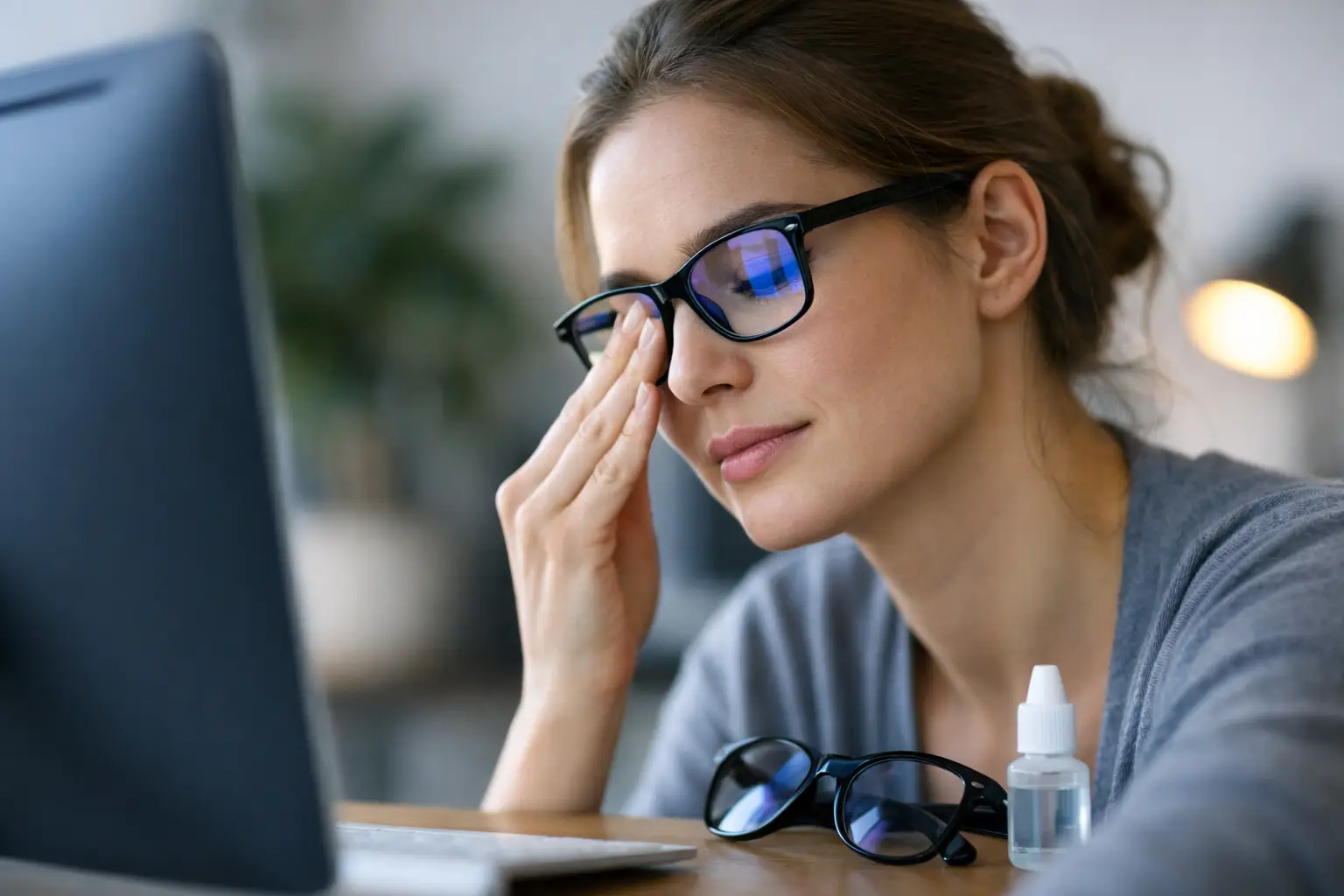
If the day ends with eyes that sting, water, or are just uncomfortably tired, the problem may not only be due to long screen time. Often, the issue is that your eyes react more sensitively to light, contrast, and dryness than usual. This is where screen glasses for sensitive eyes come into play – not just as a fashion item, but as a practical work tool for everyday use.
Sensitive eyes give quick signals. Some develop redness by the evening, others feel tension between the eyebrows, and some get headaches after just a couple of hours. If you work on a computer, study online for long periods, edit videos, or switch between your phone and laptop dozens of times a day, the strain accumulates unnoticed. A good pair of glasses won’t make the screen disappear, but it can clearly improve your daytime comfort.
Why sensitive eyes get more tired in front of screens
Watching a screen reduces blinking. This means that the eye surface dries out faster, and that alone is enough to cause stinging, blurry vision, or a desire to rub your eyes. Add bright lighting, high contrast, poor posture, and evening screen use, and sensitive eyes can quickly become a daily issue.
Blue light is not inherently an enemy, but a large amount of screen light, especially in the evening, can increase the workload for the eyes and also affect sleep patterns. For sensitive eyes, the issue is often about total load. Every little irritant counts more than for a person whose eyes can better tolerate dry air, artificial light, and long workdays.
That’s why screen glasses should not be seen as a miracle solution for everyone. They work best when the problem is specifically related to screen use, light load, and visual fatigue. If the eye is constantly painful or vision changes, glasses do not replace an examination by a specialist.
How screen glasses help sensitive eyes
The goal of good screen glasses is to reduce eye strain by filtering some of the blue light and softening the visual stress coming from the screen. Many users first notice not a dramatic change, but that at the end of the day their eyes are less dry, the head feels lighter, and evening screen time doesn’t feel as aggressive.
For sensitive eyes, lens quality is also important. Simply lightly tinted lenses don’t always give the same result as proper filter lenses designed for real use. If the lens reduces reflections and the sharp glare from the screen, the eye has to compensate less. This can mean less squinting, less tension, and calmer viewing.
Practical benefit depends on habits. If you only wear glasses when your eyes are already completely exhausted, the effect is smaller than if you put them on at the beginning of the workday or before longer studying. People with sensitive eyes benefit the most from consistency.
When screen glasses are especially a good choice for sensitive eyes
Most often, they help people who work at least 4-6 hours a day behind a screen and experience one or more typical symptoms during the day. These include dryness, tingling, glare, redness, eye pressure or heaviness. Often, evening restlessness is added because the eyes and brain do not switch off from the screen quickly enough.
These glasses are well suited for office workers, students, programmers, designers, content creators, and everyone who moves between work and leisure from one screen to another. They are also beneficial for people who wear contact lenses, as lenses can further enhance the feeling of dryness.
At the same time, it’s worth being honest—if your main eye concern is incorrect vision correction strength, then just a blue light filter will not solve it. In that case, vision needs to be corrected first, and then additional protection can be considered. For sensitive eyes, the best result often comes from the combination of several factors.
What to actually look for when choosing
The first thing is the type of lens. If you use glasses mainly during work hours, the filter should support comfortable daytime vision without colors becoming disturbingly yellow. If the goal is to reduce evening light exposure and maintain sleep, a stronger protection solution might be more reasonable. It all depends on when you wear the glasses the most.
The second important topic is the frame. With sensitive eyes, people tend to focus only on the lens, but if the frame presses on the nose, slips down, or fits uncomfortably, the glasses will just stay on the table. A light frame, good fit, and suitable size matter more than it might seem at first. Glasses must be ones you really want to wear all day, not just for ten minutes at a time.
The third point is coverage. If you look at a large monitor or work in bright conditions, a model with a larger lens surface can offer a more pleasant feeling. Glasses with small and narrow lenses can be stylish, but not always the most practical if the goal is to really relieve screen strain.
Fourth, it’s worth looking at overall quality.UV-400 protection, proper finishes, and reliable processing are not just sales words. If you wear glasses every day, the product must last and the lens must remain visually clean and comfortable.
Do all blue light glasses suit sensitive eyes?
The short answer is no. There are glasses of very different levels on the market, and appearance alone does not say much. Some models are more suitable for light evening use, others are designed for an intense workday. A user with sensitive eyes usually quickly notices the difference.
A cheaper option may be perfectly sufficient if you need light extra comfort and use screens moderately. However, if your eyes react quickly, it’s worth going for a more reliable option. The point is not only the filter but how the lens behaves overall – whether it reduces glare, whether the image remains natural, and whether the glasses are comfortable to wear for a long time.
A good sign is when the product is designed for everyday wear, not just as a trendy accessory. That’s why many Estonian users prefer a specialized selection where function and design go hand in hand. sininevalgus.ee/ is a known name in this category because the focus is specifically on the needs of screen users, not a bit of everything.
How to get more benefit from glasses
Even the best screen glasses do not fully compensate for bad work habits. If the screen is too bright, the air too dry, and breaks nonexistent, the eyes are still strained. Glasses work best when you give them a little extra support.
Keep the screen brightness balanced with the room. A screen that is too bright in a dark room is a classic strain for sensitive eyes. Similarly, it helps to regularly lift your gaze into the distance, blink more consciously, and keep the workplace lighting soft, not sharply directed at the eyes.
If you wear contact lenses, it may help to switch to glasses some days or add moisturizing drops. Sensitive eyes often need a little extra support from several directions. Screen glasses are a very strong part of this package, but not necessarily the only one.
Who suits stronger protection and who suits a lighter filter
It depends on your schedule. If you work mostly in daytime office lighting and need glasses for meetings, writing, and regular computer work, a lighter or medium filter is sufficient in many cases. This keeps the image natural and is well suited for continuous wear.
But if you use screens late at night, play games, edit, or work shifts,stronger protection may be a better choice. Especially if you feel the evening screen light keeps you too alert or your eyes get increasingly sensitive toward night. With a stronger filter, you just have to consider that the color tone may change more. Some like it, some do not.
This is exactly where you should prefer a solution that fits your real life, not just the most popular model. For sensitive eyes, the best is not the one with the most promises, but the one you use consistently and that feels good already in the first days.
A common sign that you might really benefit from these
If you instinctively lower the screen brightness in the evening, squint your eyes at the end of the workday, or feel your face is tense after a long computer day, it’s worth trying. The same applies if your eyes feel both tired and overly alert at once – like wanting to rest but the light still bothers you.
Many people get so used to discomfort that they consider it normal. In reality, the end of the workday does not have to mean dry, red, or overly tired eyes. When the right pair of glasses takes part of this burden, the difference quickly becomes noticeable.
For sensitive eyes, the best approach is simple: choose glasses that are comfortable to wear, suit your screen habits, and look good enough that you want to wear them every day. When a product works, you’ll recognize it not by the slogan, but by the fact that at the end of the day your eyes feel more relaxed and you feel better.