
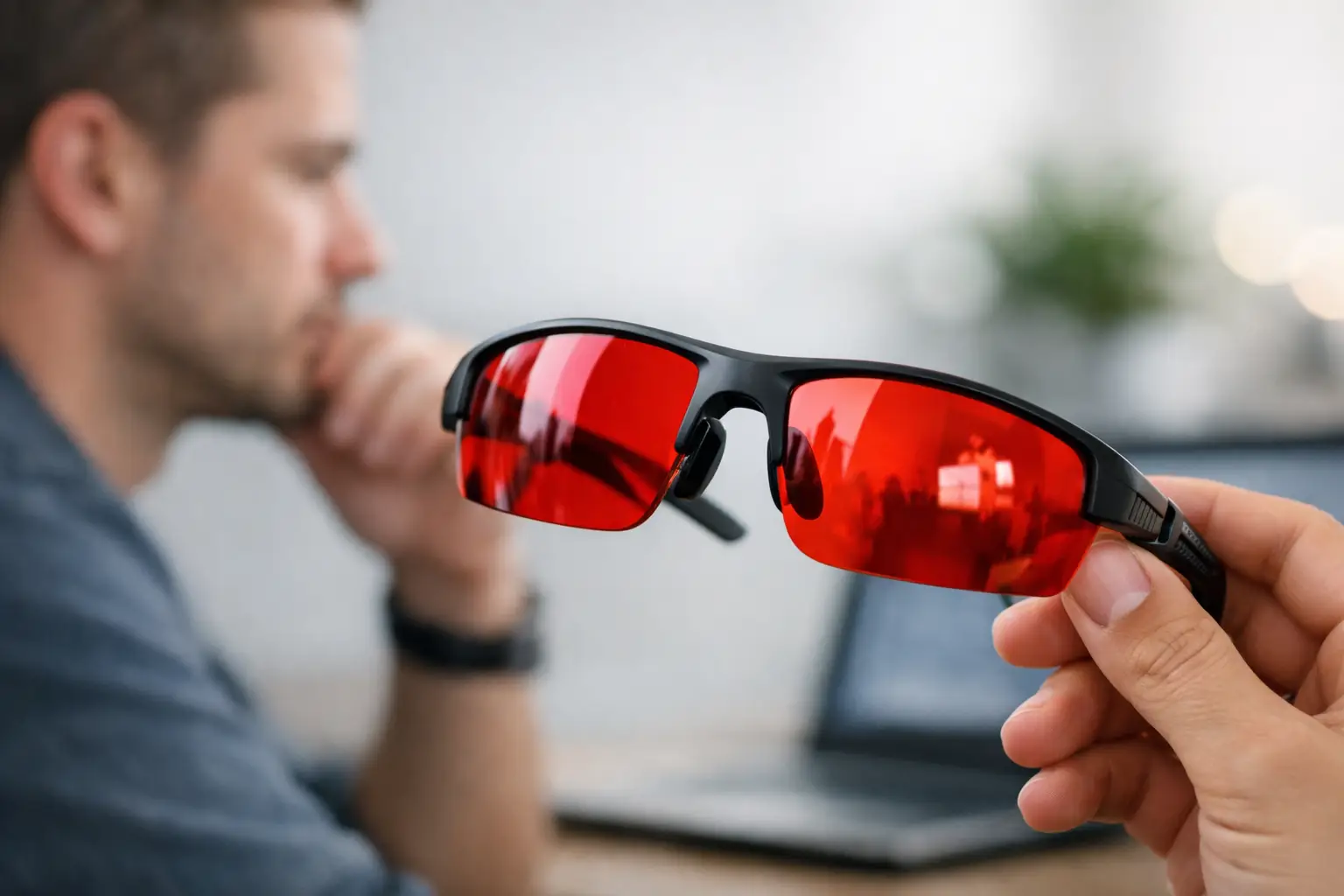
When evening screen time stretches too long and sleep won’t come at the right time, a red lens glasses review is not just interesting reading but a completely practical topic. These glasses are designed for people who want to reduce the impact of blue light in the evening much more strongly than with regular screen glasses. The question is not only about eye comfort. It’s also about how you feel late in the evening, how quickly you calm down, and whether you fall asleep more easily.
Red lens glasses are not a full-day solution for everyone. This is where the confusion arises. Some buy them hoping to solve both daytime office work and evening sleep routine with one pair of glasses. In fact, the strength of red lens glasses is in a very specific use case – primarily after sunset, before sleep, in the presence of strong artificial light and screens.
Red lens glasses review in real life
The main purpose of the red or deep amber lens is to block most of the blue light and often some of the green light as well. This makes them a higher protection level option compared to classic clear blue light glasses. While regular screen glasses are well suited for the workday, red lens glasses are intended for the moment when the day should already calm the body down, but LED lights are still on indoors and the phone is in hand.
In practice, this means a quite clear difference. Looking through the red lens, the image becomes warmer, contrast is perceived differently, and color accuracy decreases. If you are just checking emails, reading, watching a series, or scrolling through your phone in the evening, this is usually not a problem. However, if you process photos, edit color-sensitive videos, or do design work, the red lens solution may be too aggressive.
That’s why you shouldn’t judge them with a simple question: are they good or bad. The better question is: do they fit your evening routine? If the answer is yes, they can be one of the most effective additions for a person who sits in front of screens late into the evening.
How do red lens glasses differ from regular screen glasses?
The biggest difference is the strength of protection. Regular transparent blue light glasses are designed to reduce some of the high-energy light coming from screens, make long computer days more comfortable, and help reduce eye fatigue. They are everyday and visually discreet.
Red lens glasses go a step further. Their purpose is not only visual comfort but much more powerful limitation of evening light exposure. If your problem is that after a long evening of screen time you suddenly feel tired but at the same time too alert, this is where the higher protection level lens comes into play.
The downside is honestly there as well. Glasses with red lenses change the color tone of the world. Not everyone wants this every evening. For some, it feels unusual for the first couple of days, for others it remains too strong. It also doesn’t fit well in situations where you need accurate color perception or want a completely natural picture.
Who is this choice really suitable for?
The biggest beneficiaries are people whose day doesn’t end with a screen at five o’clock. If you work in a home office, study in the evenings, play games, read from your phone, or watch TV shows before going to bed, you are more likely to benefit from red lens glasses. The same applies to shift workers and those whose sleep rhythm easily gets disrupted.
A good candidate is also someone who has already tried regular screen glasses but feels the evening effect is too weak. This is a common situation. Daytime blue light glasses and evening red lens glasses do not compete with each other but serve different purposes.
However, if your main concern is only mild eye fatigue during office work, red lens may not be the first or best choice. In this case, it is often more sensible to start with regular screen glasses that are suitable for wearing throughout the workday and do not distort screen colors so strongly.
What to look for when buying?
A red lens glasses review is not complete without the most important purchasing question: how strong is the actual protection. Not all lenses with a reddish tint do the same job. Some models are more of a style element, others are truly designed to block evening blue light. Appearance alone does not show enough.
It’s worth checking if the product clearly states the level of protection and intended use. If the description remains too general, there is reason to be cautious. A good product description states directly whether the glasses are meant for daytime screen use or specifically for evening and before bed.
The second important point is the frame. If the glasses feel heavy on the nose or slide down, they are easily left in a drawer. This is a simple but decisive factor in the purchase decision. A person only wears glasses consistently if they look good and fit well. Function without comfort will not be used long.
Thirdly, it’s worth looking at UV-400 protection. If you also use glasses in daytime light or want extra protection in different lighting conditions, this is a strong plus. Although the main role of red lens glasses is evening light exposure, quality general protection gives the product more practical value.
What kind of user experience can be realistically expected?
The first effect may not be dramatic. Many people expect the glasses to make them sleepy within five minutes. Real life is calmer. More often the feeling is described as the evening becoming softer, the eyes not getting as much strain, and late evening alertness decreasing. This gradual change is often the sign that the glasses are doing their job.
If you wear them about 1-3 hours before going to bed, the result is usually more logical than putting them on only when going to bed. The body does not switch with a push of a button. The effect of light accumulates over the entire evening.
At the same time, it’s important to set expectations correctly. If you drink caffeine late, work in bed, and scroll stressed on the phone, glasses alone will not solve the whole situation. They are an effective aid, not magic. They work best alongside a normal evening routine.
Are red lens glasses suitable style-wise?
Yes, and that is not a small detail. If glasses with higher protection levels look too technical or uncomfortable, they will go unused. Today’s buyer does not want to choose between health benefits and good looks. They want both.
That is why the frame shape, tint, and overall feel are important. A classic black frame feels safe, translucent or softer tones are more modern and suit people who want their glasses to look like a conscious style choice, not just a practical tool. This is also why such products are becoming increasingly popular in Estonia – they fit naturally into everyday life.
If you choose a model you would gladly wear in front of guests, on the couch, at the computer, or on an evening walk, usage will be more consistent. And consistency is the key to the whole game in this category.
Overview of red lens glasses – pros and limitations
The strongest advantage is clear purpose. They are well suited for the evening when you want to reduce the effects of screens and strong indoor lighting more than typical glasses allow. For many, this means feeling calmer and better conditions for sleep.
Another big benefit is that the solution is simple. There is no need to set up an app, replace lamps, or endlessly adjust screens. You put on the glasses and use them. With a busy life, what matters most is whether the habit is easy to maintain.
The limitation is color distortion. If you need precise visual work in the evening, the red lens may bother you. Also, they may not be necessary for a person whose evenings mostly pass without screens. In that case, the benefit is smaller.
If you are looking for the most effective evening solution, red lens glasses are one of the strongest choices in the category. If you want universal glasses for the whole day, it is worth looking at something more neutral. sininevalgus.ee/ offers separate solutions for such different needs, and that is the most sensible approach – to choose glasses according to when and why you actually use them.
The best glasses are not the ones that promise the most on paper. The best glasses are the ones you consistently wear exactly when they truly benefit you.