
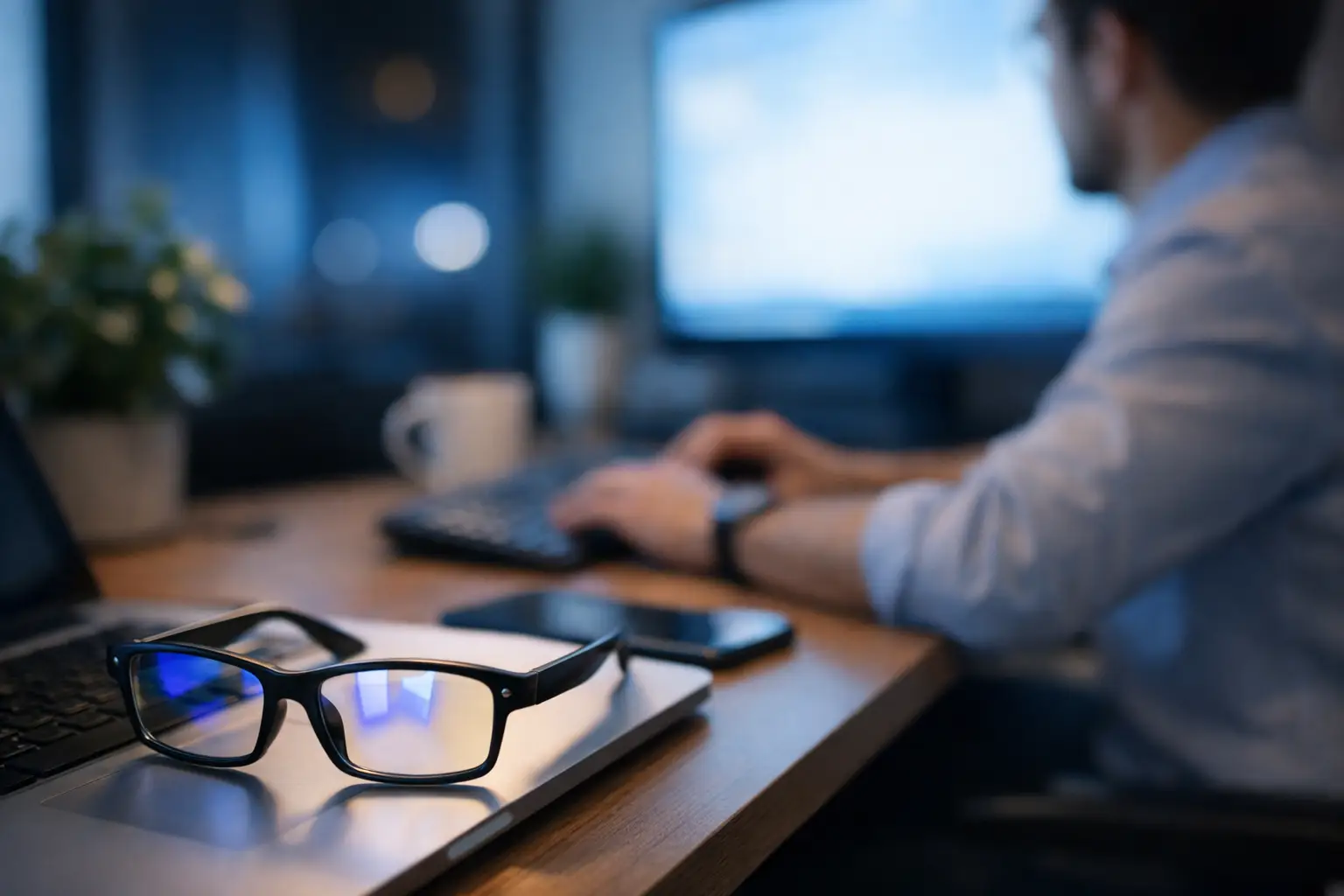
At the end of the day, your eyes sting, your head feels heavy, and you don’t fall asleep as quickly in bed as you would like. If this sounds familiar, it’s completely logical to ask: is it worth buying blue light glasses? For many screen workers, students, and creatives, the answer is yes—especially if the glasses are part of a smarter screen habit, not a hope to solve all problems with one move.
Blue light glasses don’t mean you have to give up your computer or phone. They are a simple daily aid for people whose work, studies, or leisure time are largely spent in front of a screen. A good frame fits comfortably, suits your style, and helps make long screen days easier on the eyes.
Is it worth buying blue light glasses for screen work?
If you look at a screen for several hours a day, there is a clear practical reason to buy them. Screens emit visible blue light, and in the evening, intense screen light can signal to your body that the day isn’t over yet. This can disrupt your natural evening rhythm, especially if your phone comes with you straight to bed.
The glasses filter out some blue light. Their greatest value is often in evening use and for people who feel eye strain after long screen time or have difficulty calming down after a workday. Some notice a difference quickly, while for others the experience develops over a couple of weeks. It depends on the length of the workday, screen brightness, room lighting, and also on how consistently the glasses are worn.
It is important to keep expectations honest. Blue light glasses do not improve visual acuity, do not replace prescription glasses, and do not cure persistent eye pain. If you have severe headaches, blurred vision, or an eye-related problem that does not subside, it is worth consulting an optometrist or ophthalmologist. However, well-chosen screen glasses can give a more comfortable feeling to a screen day and can be a very sensible preventive habit.
Who are blue light glasses best suited for?
Glasses are not only for programmers. An office worker jumps from a video meeting to spreadsheets, a student reads study materials in the evening, a designer processes images, and a gamer ends the day in front of the monitor. Phone use also counts – short but frequent glances at the screen add up to a noticeable amount of time throughout the day.
Glasses can be especially helpful if you work after sunset, use your phone before sleep, or feel that your eyes become dry, red, or tired in the latter part of the day. This does not mean that every discomfort is caused solely by blue light. Often, infrequent blinking, dry air, too bright a screen, and excessively long work cycles without breaks also contribute.
That is why glasses should be viewed as a comfortable additional layer, not the only solution. If you choose a frame you really like, it’s easy to wear them every day. Function and style do not have to compete here: a model with a transparent, dark, thin, or bolder frame can be as natural a part of your workspace as a good keyboard or water bottle.
Daytime screen glasses and evening red lens glasses
Not all blue light glasses have filters of the same strength.Regular screen glassesare a suitable choice for daytime work, studying, and general use of digital devices. They mostly have clear or lightly tinted lenses and are comfortable to wear during meetings, at school, and in the office.
Higher protection levelred lens glassesare primarily designed for evenings when you want to reduce the effect of screen light before going to bed. Glasses with red lenses make color perception clearer, so they are usually not the best choice for color-accurate design work or daytime wear. This is a conscious compromise: stronger evening filtering in exchange for less natural screen colors.
If your work requires precise photo editing, video editing, or design, use screen glasses during the day or work without a filter if necessary. In the evening, when the work is done and you are rather watching a series, talking on the phone, or reading, glasses with a stronger filter might be a better choice.
What should you really look for when buying glasses?
The first question should not only be the price, but when and how long you intend to use the glasses. For daily screen work, you need a light frame that does not press on your nose or behind your ears. If the glasses start to bother you after an hour, they are likely to end up in the drawer – no matter how good the filter on the lens is.
Also check the lens protection features. UV-400 protection is a useful added value because it helps block harmful UV rays. This does not automatically make screen glasses a substitute for sunglasses in very bright outdoor light, but it provides an additional layer of protection for daily activities.
The shape of the frame affects more than it seems at first glance. A slightly larger lens more comfortably covers the field of view and is well suited for working in front of a monitor. A light frame is a good choice for long working days, while a stronger frame can be a deliberate style choice. Choose a model you would willingly put on even if the workday extends from eight to ten hours.
sininevalgus.ee/ selection has both discreet and more eye-catching frames so that screen glasses don’t remain just a necessary work tool. Glasses are a visible accessory – they should support your well-being, not force you to wear something that doesn’t feel like you.
Glasses work best together with good habits
Even the best glasses will not compensate for sitting in a dark room in front of a very bright screen without breaks. Small changes will add a noticeable effect alongside the glasses. Keep the screen brightness in harmony with the room lighting, don’t hold the phone too close to your face, and blink consciously when you are focused on a spreadsheet or game.
During the workday, it’s worth regularly looking into the distance. The simple 20-20-20 rule means that about every 20 minutes you look for 20 seconds at least 20 feet away, which is about six meters. You don’t have to do this with millimeter accuracy – the goal is to let your eyes rest from focusing up close on the screen.
In the evening, it is worth lowering the screen brightness and turning on the device’s night mode. These settings do not replace glasses or device settings, but together the result is more reasonable. If sleep is important to you, try to give yourself some genuinely screen-free time in the last hour before going to bed whenever possible.
When might the purchase not be necessary?
If you use screens rarely, finish using digital devices early in the evening, and do not experience eye fatigue, blue light glasses may not be the first thing you need. Also, do not expect the glasses to solve problems caused by poor posture, dry air, or uncorrected vision.
But if the screen is your tool, learning aid, and evening entertainment all at once, the justification for the purchase is much stronger. Glasses are an easy, wearable, and stylish way to pay attention to your eyes’ comfort and your evening rhythm without having to reorganize your digital life.
The best choice is a pair that you actually wear: a comfortable frame for daytime screen work or a model with a stronger filter for the evenings. If your eyes get a bit more room to breathe during the day and the evening unfolds more calmly, this small habit has already proven its worth.