
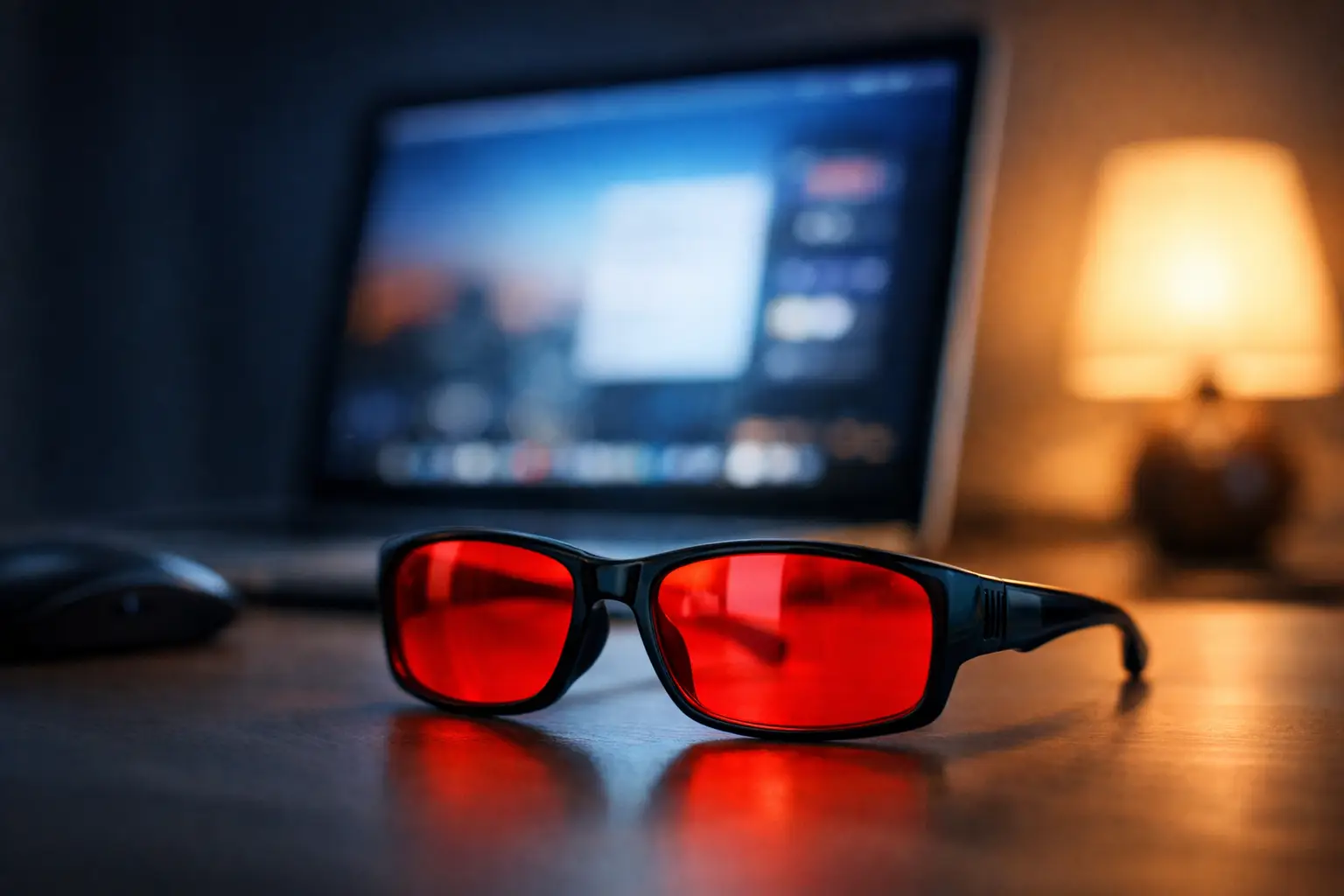
If the screen is still on at 10:30 PM in the evening, but sleep should already be quietly approaching, the quality of light becomes quite important. This is exactly where red screen glasses for evening use come into play – a solution for those who cannot or do not want to completely put away screens in the evening but want to reduce their impact on the eyes and sleep patterns.
Evening screen time is no longer an exception but a completely normal part of the day for many. Work stretches on, studying continues, the phone is within reach, and shows don’t ask what time it is. The question is not only whether the screen tires the eyes. The question is also what kind of light you let in during the evening and how it affects your well-being the next morning.
Why are red screen glasses for evening use different from regular screen glasses?
Not all screen glasses are designed for the same situation. Those used during the day blue light glasses usually have a milder filter. They help reduce the sharpness of light coming from the screen, support more comfortable viewing, and are well suited for the workday if you want protection without significantly changing color perception.
Red screen glasses have a different purpose. They are glasses with a higher level of protection, primarily designed for evening use when you want to strongly limit those light frequencies that could signal to the body that the day is still ongoing. Therefore, the red lens is a more intense choice. It is not just a style element but a functional filter for a set period.
In practice, this means that if you still do computer work in the evening, scroll on the phone, or watch television, the red lens creates a much calmer lighting environment for the eyes. The image becomes warmer and the contrast is perceived differently, but this is precisely where their strength lies.
When to actually wear them?
Red screen glasses are mostly not all-day glasses. Their best time starts in the evening, usually a couple of hours before bedtime. If you know that your evening screen time is unavoidable, it makes sense to put them on before fatigue and bright light start working against you.
A good example is a late workday in a home office. Another typical situation is studying or using a phone in bed before going to sleep. Many notice that at that time their eyes feel prickly, their head seems “too awake,” and falling asleep is delayed. Red glasses don’t make evening screen time perfect, but they help keep its effects better controlled.
If your evenings are screen-free, you may not need them that often. But if you use screens almost every evening, they are a very practical addition that supports a steady habit.
How do red lenses affect evening well-being?
Most often, people look for two things – calmer eyes and a smoother transition to sleep time. In the evening, eyes are already strained from the day. When you add bright LED light, close phone viewing, and long focus, it’s no wonder that eyes become dry, tense, or sensitive.
Red screen glasses for evening use help reduce that bright light load. Many users describe the feeling simply – their eyes don’t get “beaten up” as much in the evening. This doesn’t mean all discomfort disappears immediately or that glasses replace rest. However, they can make screen viewing in the evening significantly gentler.
The benefits near sleep time are most noticeable for those sensitive to light or whose day ends very late in front of a screen. If the body receives less bright signaling in the evening, falling asleep can come more naturally. This depends on the person, their routine, and how consistently the glasses are used. If at the same time coffee is drunk late, intense training is done, and the bedroom is kept very bright, glasses alone won’t be enough. But they can be an important part of an effective evening routine.
Red screen glasses for evening use are not suitable for every activity
It’s worth being honest here. Red lenses are a strong solution, and for that reason, they are not universal. If you need very accurate color perception in the evening, for example in photo editing, design, or video color correction, these may interfere with the work process. Colors change, and evaluating a neutral image is no longer reliable.
They are also not intended for driving or situations where you need the most natural color distinction possible. This is more of a home evening tool – computer, phone, tablet, TV, reading in artificial light.
Separation is important because the right glasses are always chosen based on the usage time. A lighter filter for the day, a stronger one for the evening. This way you get the best of both worlds and don’t have to compromise where it’s not necessary.
Who is this the most sensible choice for?
If you work behind a screen all day and find yourself on your phone in the evening, you are a very typical user. If you study late at night, edit videos, play games, read from a tablet, or reply to messages still in bed, red glasses are often a logical next step.
They are also suitable for those who have tried regular blue light glasses but feel that they are not enough for the evening. Daytime screen glasses can be comfortable and unobtrusive, but at night a stronger filter may be needed. This is where thered lens type solutioncomes into play, which is deliberately made for evening use, not just for general wear.
Aesthetics is not an irrelevant topic either. People want a product that works but also looks normal. This is a completely reasonable expectation. A good evening screen glass doesn’t have to look like lab equipment. If the frame fits well and suits your style, you are much more likely to actually use it every day.
What to look for when choosing?
First of all, the level of protection. If you are really looking for glasses with a red lens intended for evening use, then lightly tinted glass alone is not enough. The difference may seem small at first glance, but in the user experience, it is significant. The evening filter must be designed specifically to reduce the impact of strong screen light.
Secondly, comfort. If the glasses press on your nose, slip from the front, or bother behind the ears, they will just stay on the table. A lightweight frame, good fit, and reasonable size determine much more than you might initially think.
Third, visual suitability. Since it is a product used at home, in the evening, and often for longer periods, it must feel like a natural choice for you. If you like the model, you’ll reach for it faster. If not, its use will remain occasional.
For many, it also matters that the product is quickly available in Estonia and that the selection is reliable. In this respect, a specialized store has a strong advantage because the selection is made based on a specific need, not just as an additional category alongside everything else.
Are these useful even if you already use night mode?
Yes, often they are. The phone and computer night modes can help make the image warmer, but that doesn’t solve the whole situation. First, the screen still remains a light source. Second, the device’s settings may not be strong enough, especially if the brightness is high or you use multiple screens at once.
Red screen glasses work regardless of the device. This means protection remains even if you switch from phone to computer or watch TV. In practice, this is more convenient because you don’t have to rely on each device’s individual settings.
The best result often comes from a combination. Reduced screen brightness, evening night mode, and red glasses together provide a noticeably calmer effect than any one of these alone.
Do these replace a good evening routine?
They don’t replace it, but they support it very well. If you go to sleep at different times every day, drink energy drinks late, and do intense scrolling in bed as the last thing, no glasses will magically fix that system. However, life doesn’t have to be perfect to benefit.
For most people, the value is that red screen glasses make real life a little better. You don’t have to give up screens completely. You can simply reduce their impact during the time when the body would prefer to start calming down.
The selection at sininevalgus.ee includes exactly such higher protection evening solutions meant to be used when ordinary screen glasses are no longer enough. It is a practical choice for a person who wants better well-being without reorganizing their evening life.
If your evenings are spent in the company of screens, the question is not whether you need glasses at all, but whether you have the right level of protection for the eveningright level of protection. Sometimes better sleep and a calmer gaze start with a very simple habit – putting on the right glasses at the right time.