
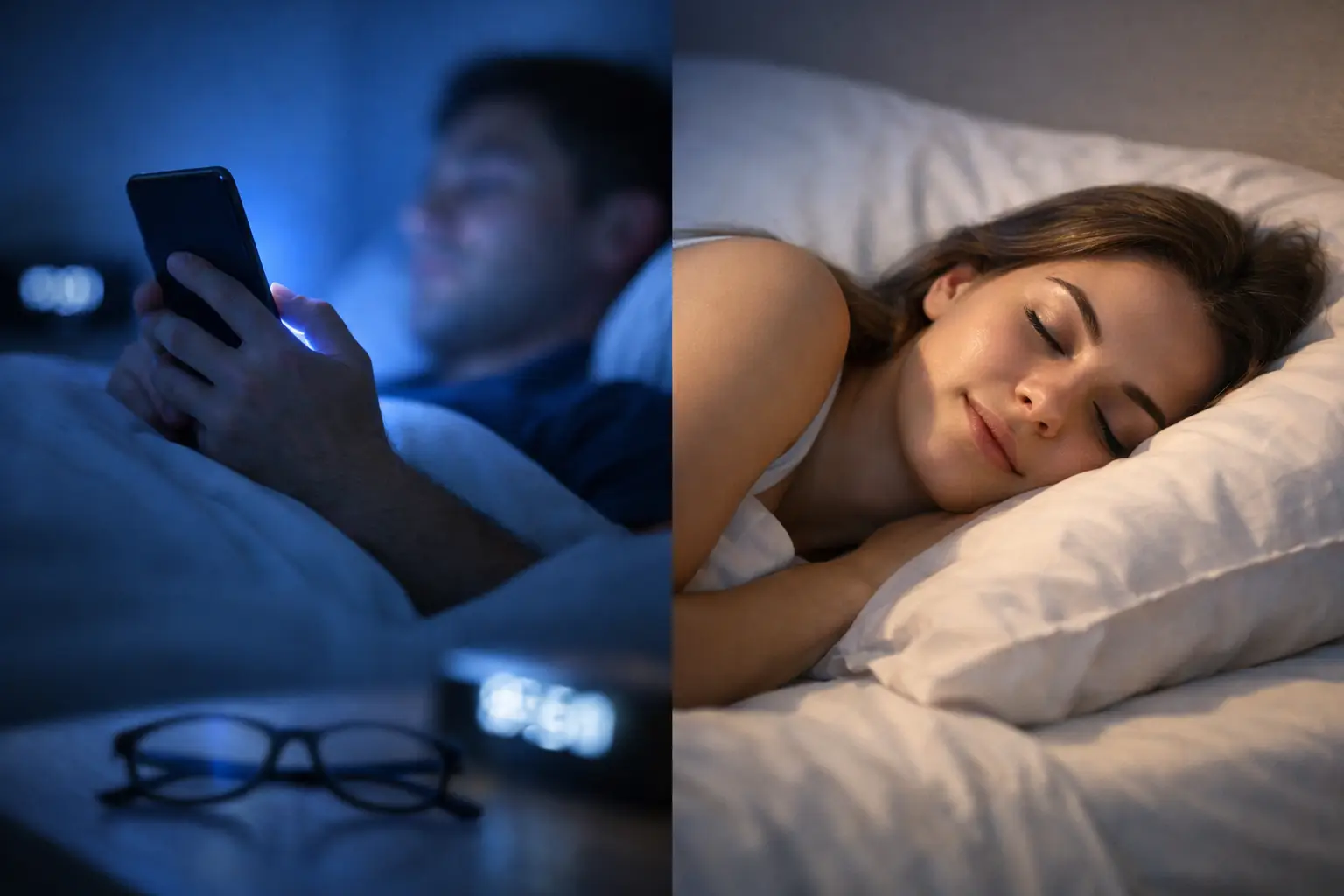
Evening often unknowingly extends in front of the screen. You watch one more video, reply to a few more messages, or scroll through your phone just out of habit – and then wonder why you can’t sleep even though your body is tired. If you have asked how blue light affects sleep, the short answer is very practical: it can shift your sleep time later, make falling asleep harder, and leave you feeling foggy in the morning.
It’s not just that the screen holds your attention. The issue is also the type of light. Phones, laptops, TVs, and tablets emit bluish-toned light, which the body reacts to differently than warmer evening light. When a person who has worked in front of a screen all day feels in the evening that their head is tired but the brain doesn’t switch off, that’s a very familiar pattern.
How Blue Light Actually Affects Sleep
Our circadian rhythm works according to light. Bright light in the morning is beneficial because it signals the body that the day has begun and it’s time to be alert. In the evening, the body wants the opposite – less brightness, less stimulation, and more relaxation. Blue light can disrupt this natural transition.
The reason is simple. Strong bluish-spectrum light in the evening suppresses the production of melatonin. Melatonin is a hormone that helps the body prepare for sleep. When its production is delayed, drowsiness also shifts later. The result is a situation where the clock shows late hours, but sleep still doesn’t seem to be truly present.
This doesn’t mean that blue light alone is to blame for every bad night’s sleep. Sleep quality is also influenced by stress, caffeine, irregular schedules, and lack of exercise. But screen light is one of those factors that can be fairly easily controlled. That’s exactly why it is talked about so much.
Why Evening Screen Time Affects Some More Than Others
Not everyone reacts to evening screen light the same way. Some might watch a series late at night and fall asleep right away. Others feel their eyes are tired after half an hour on the phone, but sleep is gone. The difference comes from sensitivity, habits, and how close and how long the screen is used.
Age and daytime workload also play a big role. Students, university attendees, office workers, designers, editors, and everyone else whose workday is spent in front of a screen already get quite a lot of blue light. When evening phone use in bed is added, the load can simply become too much.
Timing is also important. Blue light during the day is not necessarily a problem, rather the opposite. It helps maintain alertness and can support concentration. The issue arises in the evening, especially in the last 2-3 hours before bedtime. That is when the body is more sensitive to light signals.
Signs that screen light may be disrupting your sleep
The most common sign is that you fall asleep later than you actually want to. You are tired but not sleepy. Another common feeling is light or fragmented sleep – you do fall asleep, but in the morning you do not feel refreshed.
Often discomfort in the eyes accompanies sleep disturbance. The eyes may feel itchy, dry, or red. Some experience headaches or a heavy feeling behind the eyes in the evening. This does not automatically mean the problem is only blue light, as infrequent blinking and dry indoor climate also play a role. But if these symptoms recur after long screen time, the connection should be taken seriously.
Another sign is when the body is in bed but your mind keeps running. The screen does not just provide light but also information, emotions, and stimulation. So sleep problems do not arise only from the light, but from the combined effect of light and content. If you scroll through work matters, news, or intense entertainment in the evening, the nervous system may receive double the load.
How to reduce the effect of blue light in the evening
The good news is that you do not have to cut all screens out of your life. For most people, that is not realistic anyway. It is much more sensible to reduce the impact smartly so that daily life does not suffer.
Start by reducing screen brightness in the evening. If the screen shines at full power into your face in a dark room, the impact on the body is stronger. A warmer tone screen mode can also help because it reduces the bluer component. This doesn’t always solve everything but is a good first step.
Even more effective is to limit screen time immediately before sleep. If possible, make the last hour before bedtime calmer. This does not have to mean a perfect evening ritual with candles and a cup of tea. It is enough to avoid reading late work emails, put the phone farther away, and give your eyes a rest.
If your work or studies require evening screen use, it is worth considering glasses that filter blue light on. This is a practical solution especially for those who simply cannot give up screens. It can be especially useful for people who work on computers late into the night or regularly feel that after a day in front of a screen their eyes are tired and falling asleep takes longer.
Do blue light glasses really help?
The short answer – for many people they help, but expectations need to be realistic. If you wear filtering glasses in the evening, eye strain may decrease and the body receives fewer disturbing light signals. This can support relaxation and make the evening feel more natural. The difference is particularly noticeable for those who spend many hours in front of a screen every day.
At the same time, no pair of glasses is a magic wand. If you drink an energy drink late in the evening, work in bed, keep the bedroom too bright, and sleep at different times every day, glasses alone will not be enough. They work best as part of a broader evening routine.
Here the difference in filter level also comes into play. Regular screen glasses are suitable for daytime and early evening use when the goal is to relieve eye strain and reduce screen load. Glasses with a higher protection level red lens glasses are intended for stronger evening blocking if you want to cut out as much blue light as possible before sleep. The right choice depends on when you use the glasses and what you expect from them.
That’s why many users prefer a solution that doesn’t force them to choose between function and appearance. If glasses look good, they are much more likely to actually be worn. sininevalgus.ee/ has captured this logic well – protection must work, but wearing them must also fit into real life.
When the problem is bigger than just late phone use
If falling asleep is constantly difficult, you wake up frequently at night, or you feel exhausted for a long time in the morning, don’t blame the screens entirely. Blue light may worsen the situation, but sometimes stress, anxiety, sleep debt, or health issues are also behind it. In such cases, it’s worth looking at the bigger picture.
At the same time, screen light is often the factor whose change gives the fastest noticeable result. If a person reduces bright screen time in the evening or uses appropriate filtering glasses, the difference can appear in just a few days. Not always dramatically, but enough to make the evening feel less overstimulated and sleep more natural.
A simple evening strategy that really works
If you want to test whether blue light affects your sleep, do it consistently for one week. Keep screens in a darker setting during the last 2 hours before bedtime, use a warmer color tone mode, and if possible, blue light filtering glasses. If you can, leave the last half hour completely screen-free.
The point of this small experiment is not to be perfect. The idea is to notice a change. Does sleep come faster? Are the eyes less irritated in the evening? Is it easier to wake up in the morning? These are real questions you can only answer based on your own experience.
When days pass behind the computer and evenings on the phone, supporting sleep is not a luxury. It’s part of normal recovery, concentration, and well-being. Sometimes one smart change is enough for the evening not to work against you, but for you.