
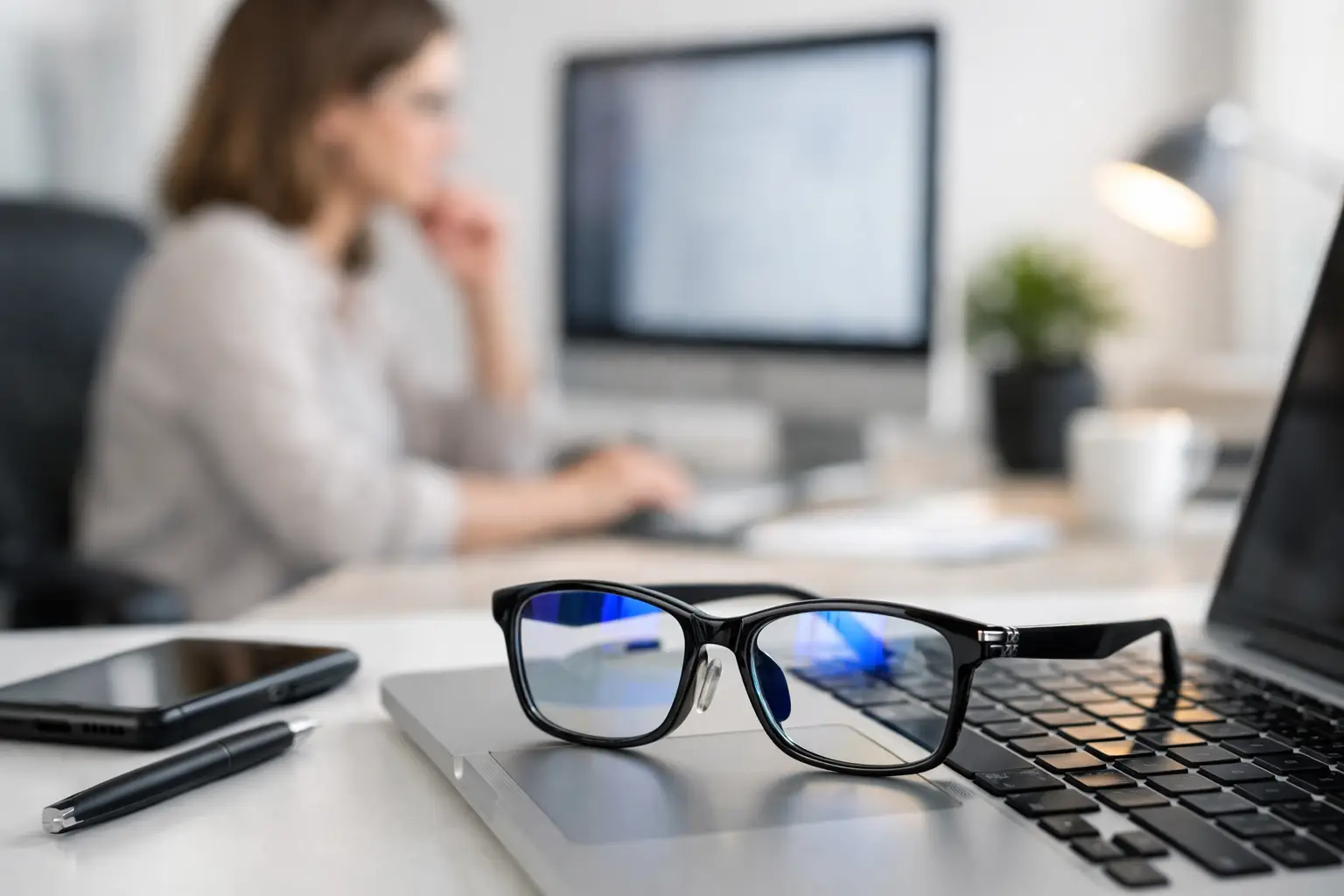
The time is 15:42, emails are coming in, Excel is open, the meeting is about to start and the eyes are already signaling enough. If the workday passes in front of a screen, eye fatigue is not an exceptional problem, but everyday reality for many. This is where screen glasses for office work come into play – not for fashion, but so that at the end of the workday the feeling is better and the gaze less tired.
Working in the office, the eyes are not only strained by the computer. There are also the phone, a second monitor, the meeting room screen, and in the evening at home, the TV or tablet. When the day consists of one long screen time, many start to feel tingling, dryness, redness, or headaches. For some, it appears only in the evening, for others already by noon. The good news is that the right pair of glasses can really make a difference here.
Why are screen glasses for office work so much in demand?
The reason is simple – screen work has become common, but eyes have not adapted to this strain. When you look at something close for a long time, you blink less and the surface of the eye dries faster. Add bright light, contrasts, and long concentration, and you get the familiar tired feeling many mistakenly consider just a natural part of the workday.
Screen glasses are designed to alleviate this strain. They do not make computer work disappear nor replace the need for sleep, but can help make a long day more bearable. Many people notice their eyes don’t tire as quickly, evening tension is less, and looking at the screen feels softer. It’s not a miracle tool but a practical instrument for everyday use.
It is also important that office work does not look the same for everyone. Some do eight hours of data input, others move between meetings and short work blocks. Some work in an open office under bright daylight, others in a home office in the dim light. Therefore, the same glasses choice is not best for everyone.
When do you really need screen glasses?
If you work behind a screen for several hours daily and notice eye fatigue by evening, then there is a valid reason. The same applies if your eyes become red, tingle, or focus seems blurrier by the end of the day. Headaches, especially in the forehead area, can also be related to long screen time.
At the same time, it’s worth being honest – if the problem comes from incorrect working posture, air that’s too dry, or the existing vision correction being no longer precise, screen glasses alone may not be enough. That’s why it’s worth looking at the bigger picture. Glasses help best when the workplace is reasonably arranged and the basic eye needs are covered.
How to choose screen glasses for office work?
The first question is simple: do you only need glasses with a blue light filter, or also vision correction? If you see well without glasses, zero power screen glasses might suit you. If you already wear minus or plus glasses, it is worth considering a solution that combines screen protection with your usual prescription.
The second important topic is the level of the filter. Not all screen glasses are the same. Some lenses filter blue light more modestly and maintain a very natural color perception. Others may offer stronger protection but make the screen image warmer. For office work, many prefer a balanced option – sufficient protection but without making white look yellow or complicating design work.
If your work depends on precise color perception, such as design, photography, or video, it’s especially worth paying attention to this. If you do rather regular office work, client communication, or analysis, a slightly warmer tone is usually quickly adaptable and even more comfortable for many.
The third point is the frame. If glasses are worn for several hours every day, the frame must fit well. A frame that is too heavy will press on the nose, too narrow a model causes fatigue, and too wide constantly slips out of place. Good screen glasses are such that after a couple of hours you no longer notice them. That is a better sign than any technical slogan.
What do good screen glasses actually do during the workday?
Most often, relief from eye fatigue is sought. This is also the most common reason why people recommend screen glasses further. When the gaze is less strained at the end of the day, it is easier to continue after work – whether it’s exercise, studying, or just an evening without feeling like your head is heavy.
The second big plus is comfort in evening screen use. Many office workers don’t stop looking at screens at five o’clock. After work, there’s still phones, series, e-shops, messages, and for some, also studies. If the day starts with a screen and ends with a screen, the right filter can help reduce that general feeling of overload, which people often simply describe as mental fatigue.
At the same time, don’t expect too much. Screen glasses do not cure burnout, do not improve bad sleep overnight, nor do they take away all headaches. When expectations are realistic, satisfaction is usually greater. They are a good support solution, not the whole solution.
Should everyone wear the same type of glasses?
They shouldn’t. If you work all day on a computer and move a lot between screens and people, a lightweight and everyday-wearable model usually fits. If your work lasts until the evening and screen time is very long, a stronger filter might be more sensible. If you do creative work, it is worth preferring a solution that minimally affects color perception.
It also matters where you work. In an open office with strong artificial lighting and many reflections, the quality of the lens coating can be especially important. In a home office, where you can control the lighting more yourself, the priority might be frame comfort or that the glasses are suitable for wearing all day, including on video calls.
The practical truth is that people only wear these glasses if they look good. If the model seems too “medical” or unfamiliar, it will stay in the drawer. That is why design is really important for office glasses. Function and appearance do not have to exclude each other.
Common mistakes when choosing screen glasses
One of the most common mistakes is choosing based only on price. A very cheap solution might seem tempting, but if the lenses distort the image, the frame fits poorly, or the wearing comfort is weak, then a habit of actually using them won’t develop. Glasses intended for office work must work every day, not just the first week.
Another mistake is thinking that the stronger the filter, the better. Actually, much depends on your work and sensitivity. For some, a stronger lens is perfect, for others it seems too tinted. The right choice is what you can wear consistently, not what looks most impressive on paper.
The third mistake is forgetting general work habits. If you sit too close to the screen, work in a room with dry air, and don’t take breaks, the effect of good glasses will also be reduced. The best result comes when several small things work together.
How to get the most out of screen glasses?
Start by wearing them consistently, not just when your eyes already hurt. Preventive use usually gives a better result than occasional wearing. Your eyes won’t feel less tired if the glasses are in the bag.
Then, review your workspace. The screen should be at a reasonable distance, light should not shine directly into your eyes, and breaks should be real breaks, not scrolling on the phone. If you add sufficient blinking and moisturizing eye drops when needed, the benefit of the glasses will become clearer.
If you are looking for an everyday solution, it is also worth considering whether the glasses need to be suitable only for work or also after work. A well-chosen model moves with you from the office to the café, from the home office to the meeting, and if necessary, to evening screen time. This practical versatility makes a single pair a good investment.
The selection at sininevalgus.ee/ is built exactly on this idea – the glasses must protect, fit well, and also look good so that you really want to wear them. This is more important for office work than it may seem at first glance.
Do screen glasses pay off?
If your working day is mostly spent in front of screens, then mostly yes. Not because they solve everything, but because a small daily comfort becomes a big difference over months. Less strained eyes, a better feeling at the end of the day, and a smaller chance that screen time will quietly eat away at your quality of life.
A good pair of screen glasses is not a luxury item for an office worker. It is a smart tool, much like a decent office chair or a well-adjusted monitor. If you spend a large part of your day in front of a screen, it is worth choosing a solution that makes that time easier on your eyes and your well-being. Because the workday can be long, but it doesn’t have to be hard on your eyes.