
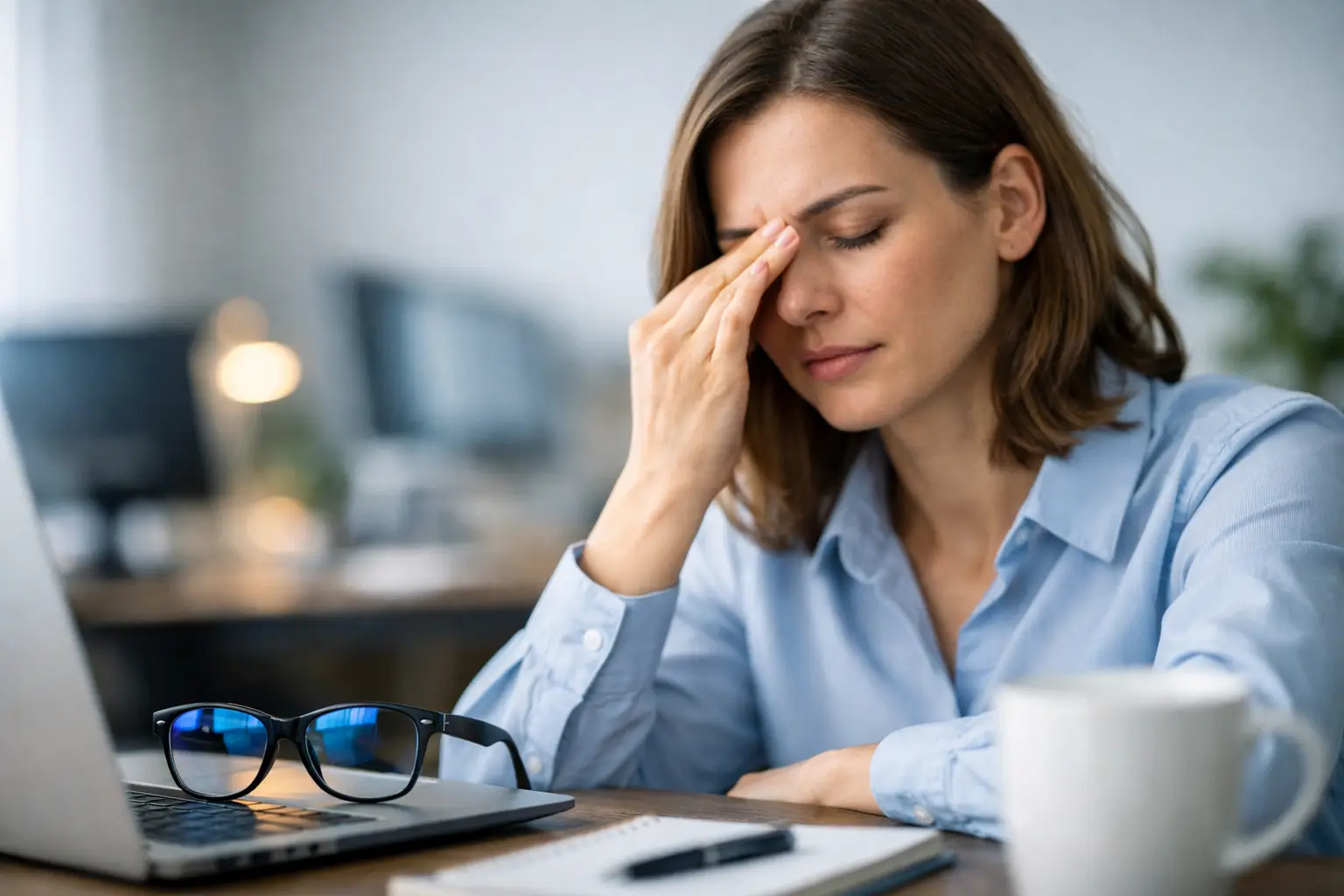
By evening, your eyes are dry, focus is blurry, and the screen brightness starts to get on your nerves? If your day is spent in front of a computer, phone, or tablet, glasses against eye fatigue are no longer a niche product but a completely practical everyday work tool. The question is not just about comfort. Often, the strain from the screen also affects concentration, work pace, and even how quickly you fall asleep at night.
Why do eyes get tired faster in front of a screen?
Reading from paper and looking at a screen do not work exactly the same way for the eyes. The light from the screen is direct, contrast changes constantly, small details require focusing, and we blink less. The result is a familiar set – dryness, stinging, redness, heaviness in the eyes, and in some cases, headaches.
Add to this the blue light issue. Not all blue light is bad, and it is also found in daylight. The problem arises more when there is a lot of screen time, few breaks, and the eyes are focused for hours in a row on a small, bright light source. Especially in the evenings, this can make you feel more restless and affect sleep more than you might initially think.
This is where screen glasses come into play. They won’t make you a different person overnight, but properly chosen glasses can take the sharp edge off your screen day.
When is it reasonable to choose glasses against eye fatigue?
The easiest test is an honest look at your day. If you work 6-10 hours behind a screen, study in online lectures, edit videos, play games in the evening, or spend a large part of the day on your phone, your eyes are under constant strain. If you also experience stinging, blurry vision, light sensitivity, or difficulty shutting down in the evening, there is reason to try a solution.
These glasses are well suited for office workers, remote workers, students, designers, and anyone whose work or leisure depends on a screen. They can also be useful if you have no vision problems or need for prescription glasses. The goal is not to correct vision but to reduce visual strain.
At the same time, it’s worth staying realistic. If you have persistent headaches, very dry eyes, or clearly worsened vision, no screen glasses will replace an eye exam. Sometimes the problem is caused by wrong working distance, a too bright monitor, poor sleep, or the need for prescription glasses.
How can these glasses actually help?
The idea of good computer glasses is to reduce eye strain during extended periods of looking at digital screens. This is usually done with a filter that helps limit some blue light and softens the visual impact of the screen. The result can be a more comfortable viewing experience, less squinting, and a calmer feeling by the end of the day.
Many users first notice a very simple change – their eyes are not as “tired” by the evening. Some experience less itching, others feel reduced pressure on the forehead or temples. Some people notice the benefit especially in the evening when screen use tends to interfere with sleep.
Is the effect the same for everyone? No. It depends on screen time, the nature of the work, lighting, and how sensitive your eyes are in general. A person who looks at their phone for two hours a day might not feel the same effect as someone who sits in front of two monitors for eight hours straight.
What is the difference between regular non-prescription lenses and computer glasses?
This is where buyers most often get confused. Regular fashion glasses without strength might look good, but if they lack a filter intended for screen use, they don’t do much to reduce eye strain. The value of computer glasses lies in the lens, not just the frame.
It is important to see if the glasses are specifically designed for digital device use. If the product has a blue light filter, it can actually be beneficial. If it also includes UV-400 protection, especially if you wear the same glasses in different environments or choose a multipurpose solution.
Design is not a side issue here. If the glasses do not fit comfortably or you don’t like their appearance, they end up in the drawer. That’s why the best solution is one where function and style go together. Nowadays, you don’t have to choose whether glasses are useful or look good.
How to choose the right glasses against eye fatigue?
When choosing, it’s worth starting with your habits, not just the price. If you use screens mainly for work during the day, a classic pair of screen glasses that helps reduce blue light exposure is usually enough. If your screen time often extends late into the evening, a solution with a stronger level of protection might be more reasonable.
The second important thing is the frame. A frame that is too heavy will bother on the nose, a model that is too narrow presses on the temples, and one that is too large may move uncomfortably on the face. If you wear glasses for several hours straight, fit becomes as important as the lens properties.
Thirdly, think about where you will wear them. If you want one pair for the home office, office, and café, choose a neutral model that suits everyday style. If you prefer glasses to be part of your look, it’s sensible to choose a frame you really want to wear. This sounds simple, but this often determines whether the product becomes a habit or a one-time purchase.
When to expect a quick effect and when not?
Some people feel the difference on the same day. The screen seems softer, eyes don’t crave a break by evening, and the overall state is calmer. For others, the effect develops during a week with consistent use of the glasses.
If you expect all symptoms to disappear with just glasses, the picture becomes too black and white. If the monitor is too close, the room is dark, the air is dry, and breaks are missing, the good effect of the glasses will be limited. The best result comes when glasses are part of reasonable screen hygiene.
This means simple things – keep the screen at a proper distance, reduce excessive brightness in the evening, blink more consciously, and get up occasionally. Glasses help, but they work best when you don’t work against them.
Is a yellow-tinted lens better?
It depends on the purpose. Slightly tinted lenses often filter more blue light and can provide noticeable relief, especially in the evening. However, the color tint may bother those whose work relies on very precise color perception, such as designers, photographers, or video editors.
In that case, a balance must be found. A solution with a more subtle filter might be suitable for daytime work, while a stronger protection is good for use in the evening. If your goal is primarily eye comfort and better evening well-being, tinted lenses can be a very good choice. If you need absolute color accuracy, you should be more selective.
Are these glasses suitable for a person without vision problems?
Yes, and very often, they are bought exactly for such people. Screen glasses are not only for those who already wear prescription glasses. Many active screen users see well but feel clear eye strain by the end of the day. In this situation, zero-prescription lenses with a filter are a completely logical solution.
If you already wear prescription glasses, another question is whether you need a separate pair for screen use or a special lens solution. It depends on your prescription and work. Some find one universal pair enough, others prefer a separate pair of screen glasses for the workday.
Why do people end up actually continuing to wear them?
The reason is usually not technical but very practical. When your eyes are not as red by the evening, the workday feels less exhausting, and being in front of the screen is simply more comfortable, wearing glasses becomes a routine. It’s similar to a good office chair – you can manage without it at first, but afterward, you don’t want to go back.
Good screen glasses are an everyday aid, not a medical miracle. They don’t have to promise too much if they do one thing well – help you feel better in front of the screen. That’s exactly why the specialized selection on sininevalgus.ee/ is convenient for the consumer. Deciding is easier when products are designed to solve a specific problem, not just to fill the shelf.
If you spend a large part of your day in front of screens, it’s worth choosing a solution you’ll gladly use every day. Because eye comfort is not a luxury – it’s a perfectly normal standard to allow yourself.